
Best LED Emergency Exit Signs for Businesses, Warehouses & Offices
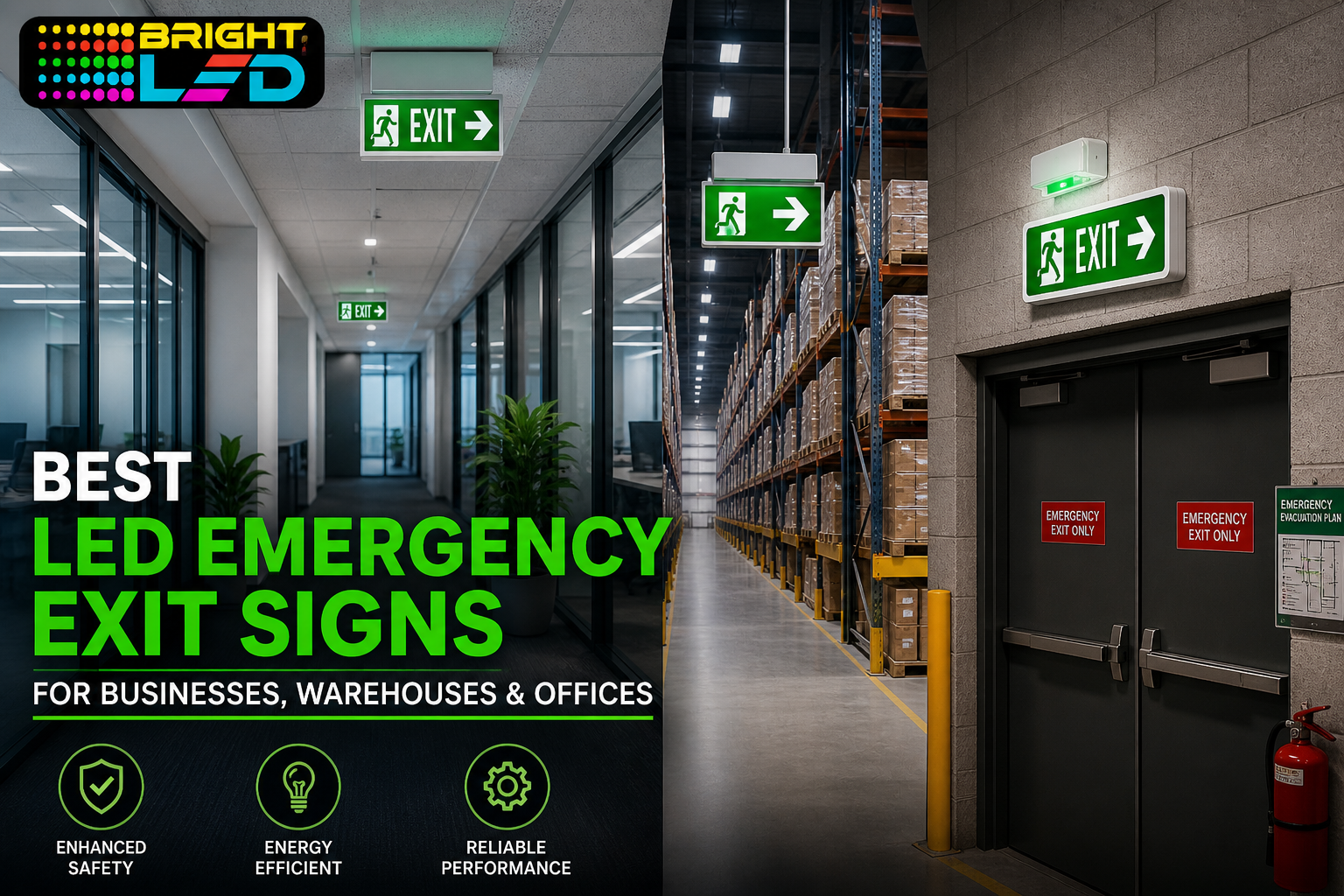
Best LED Emergency Exit Signs for Businesses, Warehouses & Offices
All in an instant, an ordinary day at work suddenly turns into an evacuation. No matter if it's caused by fire damage to one room or a whole power outage in the grid, the conditions inside your business premises change drastically. At such times, good visibility will help you stay alive. Today, in 2026, the simple exit sign is not just an item you hang on your building walls to comply with federal safety standards. Rather, it becomes your best ally in an emergency situation.
This guide examines the best ways to choose your LED exit signs depending on their appearance and durability while making sure your facility will comply with all OSHA and NFPA standards.
The Regulatory Foundation: OSHA and NFPA 101
The fixtures you select might be in terms of architecture, your choice depends on whether they comply with two primary regulations that define the safety conditions in the USA.
OSHA Requirements (Standard 1910.37)
First of all, there is the Occupational Safety and Health Administration (OSHA), which deals with all matters related to workplace safety. The mandates issued by this agency are clear: every exit on your business premises must be easy to see and accompanied by the respective signage. They are as follows:
● Lettering: The word "EXIT" must be in plainly legible letters at least 6 inches high.
● Stroke Width: The principal strokes of the letters must be at least 3/4 of an inch wide.
● Illumination: Signs must be illuminated to a surface value of at least five foot-candles by a reliable light source.
NFPA 101: The Life Safety Code
The NFPA dictates the performance of these signs in terms of technical requirements. Their most critical mandate is the 90-minute rule. If the power goes out, an emergency exit sign must provide illumination using an emergency backup battery source or emergency generators for a minimum of one-and-a-half hours. This duration is calculated to allow even the largest, most complex buildings enough time for a total, orderly evacuation.
Best Solutions for Commercial Offices: The "Edge-Lit" Standard
When you have corporate offices or professional medical suites, parking lot aesthetics is a priority. The last thing you need are bulky industrial-grade hardware ruining your design. For these environments, edge-lit LED exit signs are the premier choice.
Why They Work
Edge-lit signs feature a high-grade acrylic panel with the "EXIT" legend etched into the surface. The LED bulbs are housed within the aluminum or thermoplastic frame, allowing light to "infiltrate" the edges of the acrylic, giving a sleek, minimal look where only the letters are illuminated.
Key Features for 2026
● Recessed Mounting: Edge-lit signs have the ability to be mounted into a ceiling housing unit, providing only the acrylic portion to be visible.
● Single or Double-Sided: Panel designs can include a "mirror," allowing 360-degree viewability for open-concept offices.
● Architectural Finishes: Finished in brushed aluminum, white, or black colors to complement modern office hardware.
Industrial Strength: Best Exit Signs for Warehouses
A very tough environment, such as in warehouses and distribution centers, requires lights that are built to withstand harsher conditions. There may be tall ceilings, dust, vibration from forklifts, and no environmental temperature controls.
Thermoplastic "Combo" Units
In a sprawling warehouse, you often need both an exit sign and emergency path lighting. LED Exit/Emergency Combo Units are the most efficient solution here. These fixtures feature the standard "EXIT" sign with two adjustable "bug-eye" LED lamps on the sides.
● High-Output LEDs: Warehouse ceilings are high. You need high-lumen emergency heads that can throw light down 30+ feet to reach the floor.
● Impact Resistance: Look for units constructed out of injection-molded, V-0 flame-retardant thermoplastic material. Such units can handle accidents and are vibration-resistant, able to withstand mechanical shocks caused by industrial equipment.
NEMA 4X and Wet-Location Rated Signs
In case there are cold storage areas, loading docks, or wash-down areas in your building, wet location-rated exit signs must be installed. These units have seals and gaskets to guard against dust, moisture, and icing of the internal battery and electronics. As early as 2026, most of these units will come equipped with battery heaters to ensure operation in a Texas freeze or high-humidity summer.
The Professional Choice: Self-Diagnostic (SD) Technology
One of the biggest headaches for facility managers is the manual testing requirement. NFPA 101 requires every sign to be tested for 30 seconds every month and 90 minutes every year. In a large office or warehouse, this can take a maintenance team days to complete.
Self-diagnostic LED exit signs eliminate this labor cost. These units have an internal microprocessor that performs the monthly and annual tests automatically.
● Visual Status Indicators: A small LED light on the bottom of the sign indicates the system's health. A green light indicates all is well inside. A flashing red light tells about a definite problem—a failure of the battery, the LED board, or the charger.
● Maintenance Efficiency: Instead of testing every light, your team simply walks the halls and looks for the "red flags." This reduces labor hours by up to 80%, providing a massive ROI for large-scale businesses.
High-Risk Environments: Explosion-Proof and Steel Signs
Certain businesses require an even higher level of protection. For chemical plants, oil refineries, and other industrial areas with hazardous atmospheres, explosion-proof LED exit signs are required by law. The housing of such signs is made of heavy-duty, copper-free aluminum casting that prevents any sparks from causing explosions of flammable vapors or dust inside the sign itself.
Steel 20-gauge exit signs provide the best protection against vandalism. These "vandal-resistant" units use a polycarbonate shield covering to keep your signs undamaged by any external influences.
Installation and Maintenance Checklist
To remain OSHA and NFPA compliant, follow this installation strategy:
- Placement: Signs must be placed at every exit door and at every "decision point" in a hallway where the path of travel isn't immediately obvious.
- Directional Chevrons: Use the "punch-out" arrows found on the side of the sign to indicate which way leads to the exit. Make sure you punch out the one that takes you to safety; a double-headed arrow pointing in different directions may lead to fatal misunderstandings.
- Mounting Height: Usually, it is best to mount the signs over the door, but the bottom of the sign cannot be higher than 80 inches from the ground.
- Battery Replacement: Although the lifetime of the LED is up to 10 years, batteries (Ni-Cd or Li-Ion) will need replacement every 5 to 7 years.
FAQs
What is the difference between red and green exit signs?
As far as the federal code goes, either color is permissible. Sometimes, however, there may be a city code preference. Green may mean "go / safety," whereas red traditionally means "fire/emergency." Check with the local fire marshal before deciding.
Do "Glow-in-the-Dark" signs meet OSHA standards?
Yes, but as long as they are UL 924 approved and installed in such places where enough ambient light can charge them. They are great for saving energy because they do not require any wiring, yet they are not appropriate for basement storage areas or dim places.
Can I use a "Combo" unit everywhere?
Combos would be perfect for the corridors and exits, but in small offices, bug-eyed light would be too much. Edge-lit signs should do the job perfectly for the offices and provide the right look for them.
The Bottom Line for Your Business
It is important to think about the future of the business, and buying a top LED emergency exit sign now can be considered preparation for that future. The year is 2026, and the technology is already here, which allows the creation of a sign that requires no maintenance because of self-diagnosis and efficient LED lights. It doesn’t matter whether your preference is an edge-lit sign or a thermoplastic combo sign—both will help keep you safe and sound.
No need to wait until an inspection shows that your building needs better lighting. Do it now and don’t leave anything to chance.


-
Straight vs. Tapered Light Poles: Which Offers Better Structural Integrity?
 June 9, 2026
 -
How to Choose the Right Commercial Light Pole: Steel vs. Aluminum
 June 5, 2026
 -
Best Practices for Specifying Round Steel Poles for Commercial Parking Lots
 June 2, 2026
 -
LED Emergency Exit Signs: Installation Guide for Commercial Buildings (2026)
 May 26, 2026
 -
LED Emergency Battery Backup Systems for Commercial Lighting & Businesses
 May 23, 2026