
How Texas Heat Affects LED Lifespan
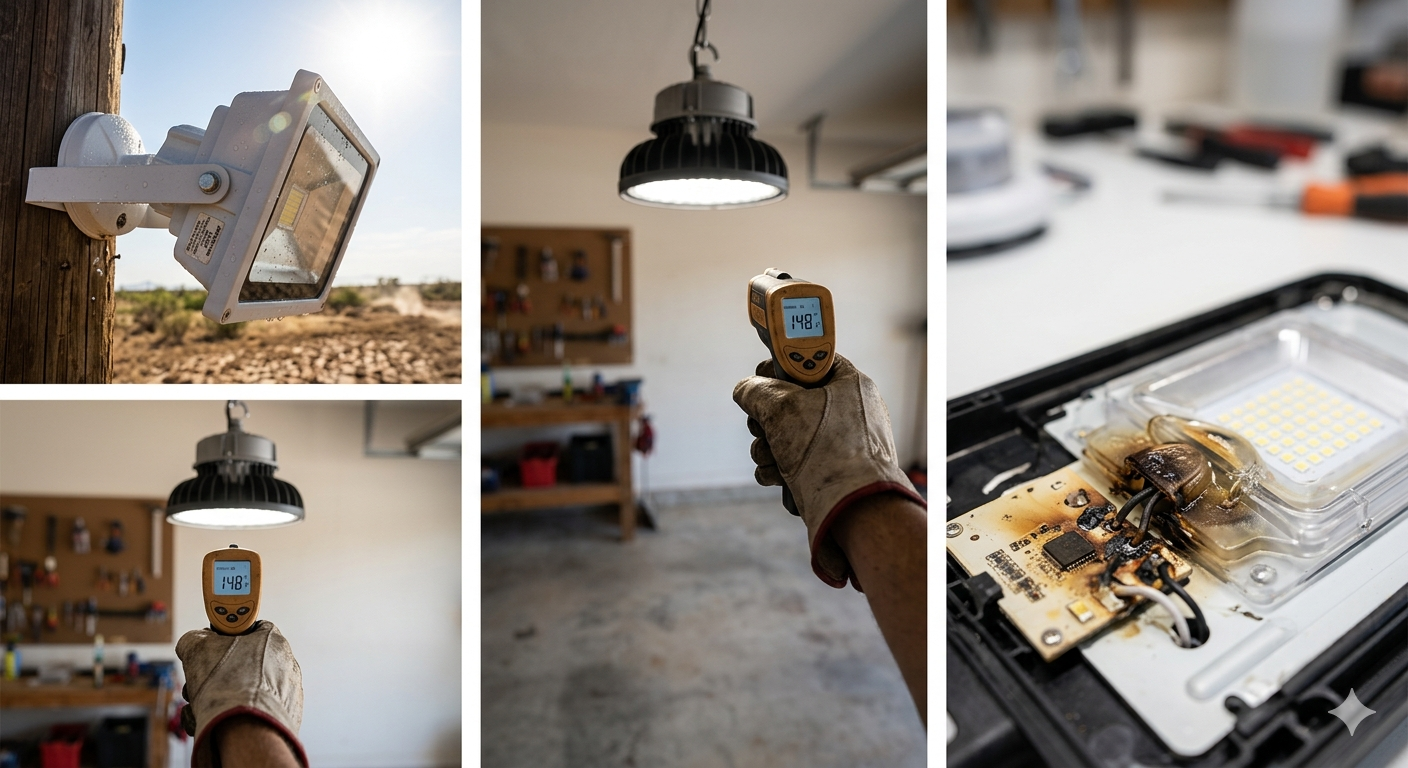
In the heart of Texas, we don't just have "summer"; we have a relentless thermal marathon. For businesses in Houston, Dallas, and San Antonio, the climate is a major stakeholder in your operational budget. While high-performance commercial LED lights have a lifespan of 100,000 hours, this is based upon “ideal” conditions (i.e., around 25°C or 77°F).
In a Texas warehouse where the ceiling temperature is often over 120°F, your LED lighting is constantly under attack. At Bright LED, we specialize in heat-resilient installations that ensure your investment survives the "Texas Burn."
The Physics of the Texas Burn: Why Heat is the Enemy
Semiconductors are LEDs (light-emitting diodes). In contrast to the incandescent lighting that produces most of its power as infrared light (light beams), LEDs are cool at the front but warm up at the back of the chip. This heat needs to be cooled out of the junction, which is where light is transformed back to electricity.
Accelerated Lumen Depreciation (The Dimming Effect)
LEDs don't "burn out" like a candle; they slowly lose their "juice." This is called lumen depreciation. In extreme heat, this process goes into overdrive. The End of the Light's Life: Industry standards, such as the L70 rating, state that the end of the light's useful life is when it reaches 70% of its original brightness.
The 10°C Rule: The most common engineering rule of thumb is that for each 10°C (18°F) increase in operating temperature, the lifespan of the LED is reduced nearly by half.
The "Color Shift" Phenomenon
Ever seen some parking lot lighting, which is blue, pink, or sickly yellow? That is probably due to the heat damage on the phosphors. Several high temperatures change the color of the chemical coating on the chip permanently. This tarnishes your professional reputation and, in other scenarios, renders your facility less safe since the quality of facial recognition on your security cameras is minimized.
The Driver: The Most Sensitive Part of Your Light
No one thinks about the fact that the most sensitive part of the light, the part that is going to cause the most problems, is the "brain" of the light, the LED driver.
According to failure analysis, over 90% of LED fixture failures originate in the driver, not the chips. Drivers contain electrolytic capacitors that act like tiny batteries. In the stagnant, 130°F air of a Texas warehouse ceiling, these capacitors can dry out and fail, leading to flickering, buzzing, or total "blackouts" in your critical work zones.
5 Must-Have Features for Texas-Spec Lighting in 2026
When shopping for lighting in the DFW Metroplex or Houston, a "standard" LED isn't enough. You need "Texas-Spec" hardware:
1. Passive Aluminum Heat Sinks
Avoid plastic or thin alloy housings. Pure, extruded aluminum with deep vertical fins provides the maximum surface area for heat to escape via convection.
2. Thermal Foldback Protection
High-end drivers now feature "thermal foldback." If the light determines it is getting too hot, it will automatically dim itself by 10 to 20 percent to protect the internal circuitry of the light until the temperature comes back down.
3. Vented "Flow-Through" Housing
Look for fixtures with a gap between the driver and the LED board. This allows Texas air to circulate through the unit, preventing a "heat pocket."
4. IP66 & Corrosion Resistance
Humid Houston is the place where salt air mixed with heat equals fast corrosion. An IP66 sealed enclosure does not allow moisture to get into the sealed, heatable parts.
5. Remote Driver Capabilities
For ultra-high-heat environments (like foundries or unventilated mezzanines), we can install the drivers several feet away from the light source in a cooler zone.
The Performance Face-Off: Standard LED vs. Bright LED Texas Solutions
|
S.No |
Feature |
Standard Contractor LED |
Bright LED Industrial Solution |
|
1 |
Operating Temp Rating |
Up to 104°F (40°C) |
Up to 149°F (65°C) |
|
2 |
Housing Material |
Thin Die-Cast / Plastic |
Cold-Forged 1070 Aluminum |
|
3 |
Driver Life (at 120°F) |
~25,000 Hours |
100,000+ Hours |
|
4 |
Color Stability |
Shifts in 2-3 years |
Stable for 10+ years |
|
5 |
Maintenance Burden |
High (Annual replacements) |
Virtually Zero |
Defeating the Heat in a North Texas Logistics Hub
A distribution center in North Dallas was losing 20% of its overhead lighting every summer. The cost was not just the cost of the lights, it was the $1,200 weekly cost of renting a scissor lift to get to the 40-foot ceilings.
We replaced the generic 400W metal halide lights with 150W high ambient LED high bays that are designed to operate in a 65°C environment.
The client saved $1,800 per month on electricity costs and eliminated their $5,000 per year budget for maintenance. The client got a 14-month ROI, and it was all due to the lights being able to withstand the stagnant Texas ceiling heat.
Unlocking the Free Capital Blueprint: Texas Energy Rebates
Don't let the upfront cost of premium, heat-rated lighting deter you. Because these fixtures are more efficient and last longer, utility providers want you to install them.
We help our clients navigate the Oncor Commercial Incentives in Dallas or CenterPoint Energy Rebates in Houston. These programs can often cover 30% to 50% of your total project cost, effectively giving you the highest-quality hardware for the price of "budget" lighting.
FAQs
Do LEDs really save on AC costs?
Absolutely. There is a global disparity between a 400W metal halide and one 150 W LED. Basically, a 400W metal halide is a space heater. You save not only the 250W of light energy, but you also save the 250W of heat energy that you don't have to struggle with using your AC for.
Can I use residential LEDs in my warehouse?
Never. The residential bulbs are rated at a 25°C (77°F) environment only. The bulbs will have a high probability of failure within the first 6 months of the summer season in a warehouse in Texas.
Is "Instant-On" affected by heat?
No. Light bulbs have instant on, unlike other kinds of light bulbs; however, the driver can get too hot, and hence it will take a few seconds to come on or flicker briefly when it is first switched on.
How do I know if my current lights are failing due to heat?
Look for the lens to take on a yellowish color, the light to take on a bluish color, or the driver to "buzz" when it has been on for more than 4 hours.


-
Straight vs. Tapered Light Poles: Which Offers Better Structural Integrity?
 June 9, 2026
 -
How to Choose the Right Commercial Light Pole: Steel vs. Aluminum
 June 5, 2026
 -
Best Practices for Specifying Round Steel Poles for Commercial Parking Lots
 June 2, 2026
 -
LED Emergency Exit Signs: Installation Guide for Commercial Buildings (2026)
 May 26, 2026
 -
LED Emergency Battery Backup Systems for Commercial Lighting & Businesses
 May 23, 2026