
What is LED Emergency Battery Backup? Complete Commercial Guide (2026)
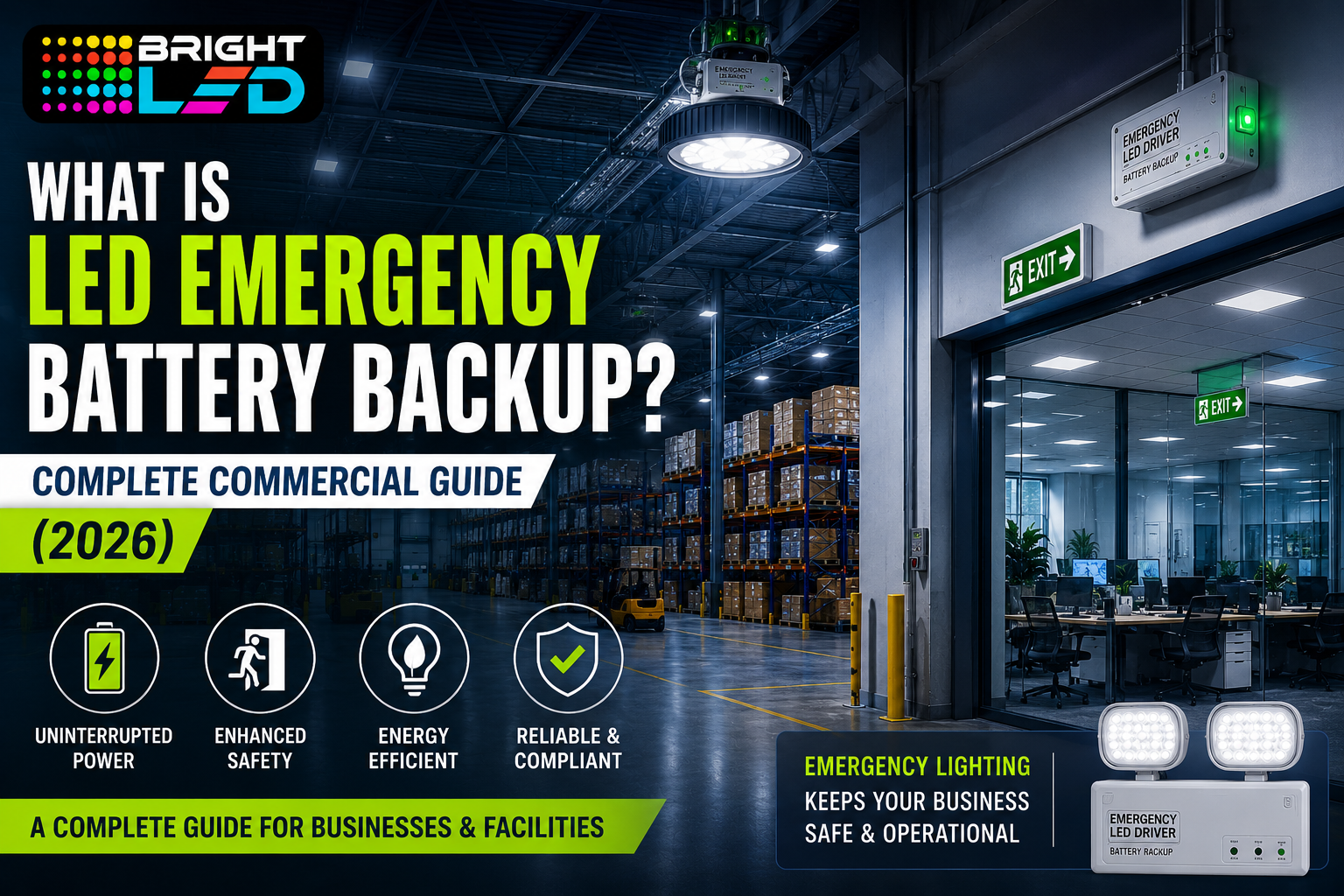
What is LED Emergency Battery Backup? Complete Commercial Guide (2026)
The point where a commercial building transitions from regular power to darkness is a critical juncture where every second seems to drag. Whether you are equipping a high-rise office building in the Houston Energy Corridor or a logistics center located next to the Port of Houston, the following tips should come in handy. We are no longer in the era of simple "bug-eye" lights that sit dormant on walls. We are in the era of LED emergency battery backup systems, highly sophisticated, solid-state life-safety assets that are integrated directly into the building's infrastructure. Advanced solutions such as the UFO Emergency Driver 40W BillDa are becoming an essential part of commercial lighting strategies, delivering reliable emergency illumination, enhanced safety compliance, and long-term energy efficiency.
In this exhaustive 2026 commercial guide, we will break down the mechanics, the legal requirements, and the strategic financial benefits of modern emergency lighting. Regardless of whether you are installing your system in Houston or elsewhere, this guide is going to outline how to install your facility legally, safely, and profitably.
The LED Emergency Battery Backup
To understand the value of this technology, we must first define what it is. An LED emergency battery backup such as the UFO Emergency Driver (also known as an EM driver or EM pack) is a specialized power management system installed within or alongside an LED fixture. Its sole purpose is to detect a loss of AC power and immediately switch to an internal DC battery source to provide a minimum of 90 minutes of illumination.
In 2026, the technology has reached a point of "seamless integration." Unlike legacy systems that required a separate, bulky housing, modern solutions often considered the Best LED Emergency Battery Backup options for commercial facilities are now tucked invisibly into the drivers of office lighting systems or integrated within the heavy-duty housings used in warehouse LED lighting.
The Three Pillars of the System:
- The Intelligent Driver: It is the unit responsible for monitoring the line input voltage. The device is called a gatekeeper because it ensures that during normal operations, the LEDs use building power as the source, while the battery is 100% charged.
- The Solid-State Battery: As opposed to using heavy lead-acid batteries, LiFePO₄ is preferred for its lighter nature, better Texas heat resistance, and longevity of up to ten years.
- The Transfer Switch: An ultra-fast electronic switch that activates the battery in less than 0.1 seconds after power loss, preventing the "flicker" that can lead to disorientation during a blackout.
[Request Free Lighting Consultation]
Engineering for the American Landscape: Codes and Compliance
In the United States, and specifically within the strict building codes of major Texas metros like Houston and Dallas, emergency lighting is governed by a trio of regulatory bodies. Failure to comply with these doesn't just result in fines, it can lead to a complete "stop-work" order or the voiding of your commercial insurance policy.
The UL 924 Standard
UL 924 is the main standard for testing emergency lighting products. By the year 2026, having a UL 924 listing will become mandatory as it certifies that the product will:
● Activate automatically upon power failure.
● Remain illuminated for at least 90 minutes.
● Provide a minimum of 1 foot-candle of light along the path of egress.
NFPA 101: The Life Safety Code
Location requirements are established by the NFPA 101 standard. According to it, all exit routes must be adequately illuminated, regardless of whether these exits include corridors, stairs, or doorways. The organization has established the so-called "90-minute rule." The basis for this regulation is the average time needed for emergency services to respond and evacuate the premises of a large commercial enterprise.
OSHA Requirements
OSHA is primarily concerned with safety in the workplace. For instance, in the case of a warehouse or manufacturing facility, OSHA requires enough lighting to avoid "struck by accidents." If your warehouse LED lighting fails and a forklift operator strikes a rack because they couldn't see the floor, the liability rests solely on the property owner if the emergency backup system was non-compliant.
The Industrial Standard: Warehouse LED Lighting & Backup
For massive industrial spaces, the challenges are height and environment. In a Houston distribution center with 40-foot ceilings, a wall-mounted emergency light is practically useless; the light won't reach the floor with enough intensity to be safe.
Integrated High-Bay Backups
In 2026, the "best practice" is to use warehouse LED lighting with integrated battery backups. These fixtures are mounted exactly where the light is needed. During a failure, the backup driver powers a portion of the LED array (typically 15W to 30W), which thanks to the fixture's high-mounting optics, provides a wide, even throw of light across the warehouse floor.
Thermal Resilience in Texas
One of the most significant ROI factors for Houston businesses is thermal management. The internal temperature inside warehouses is capable of rising to 120 degrees Fahrenheit near the roof. Traditional Nickel-Cadmium (Ni-Cd) batteries would degrade within two years due to the temperature. In our LiFePO₄ systems, special separators are used that can withstand high temperatures, preventing degradation of the battery, which means you do not need a bucket truck to install new batteries annually.
Aesthetics and Wellness: Commercial Office Lighting
In the professional high-rises of the Energy Corridor, "visual comfort" is a premium asset. Property managers want life-safety compliance without the industrial look of traditional emergency hardware.
The "Invisible" Backup
Modern Commercial Office Lighting utilizes ultra-slim LED panels and recessed troffers where the emergency battery is actually built into the driver box above the ceiling. Upon activation of an emergency system in case of a blackout, the whole panel dims down to only 15% brightness level. Thus, sufficient illumination of the building is ensured; however, this dimming prevents any "spotlight effect" associated with older systems.
Human-Centric Safety
In addition, because the LED lights used in our systems feature high CRI (Color Rendering Index), color fidelity is preserved. This enables accurate color perception by building occupants of color-coded safety signs and floor marks during evacuation.
Perimeter Protection: Parking Lot Lighting & Exterior Safety
A building's path of egress doesn't end at the front door; it ends at the "public way" or the assembly point. For many Houston businesses, this means crossing a dark parking lot.
Dusk-to-Dawn Resilience
Parking lot lighting with backup is necessary for shopping centers and round-the-clock operating industries. These lights are designed to operate in driving rains and humid conditions without compromising the integrity of the electronics inside. In 2026, area lights with Emergency batteries as backup are commonly used with photocells. This will help avoid wasting the battery's cycles by engaging the battery in case of a loss of power during the nighttime period.
Security Continuity
Maintaining light during a blackout period helps ensure your surveillance cameras with high-resolution cameras can work well during emergencies. A poorly lit parking lot attracts criminals, while those with battery backups remain protected until the power grid returns.
Modernizing the Grid: LED Retrofit Solutions
For property owners who aren't ready for a full-scale renovation, LED Retrofit Solutions offer a middle ground. If your existing fixture housings are in good condition, we can install a "field-installable" emergency kit.
The Retrofit Advantage:
● Cost Efficiency: You save on the cost of the metal housing and the labor of tearing out the old system.
● Rapid Compliance: A skilled electrician can often retrofit an entire floor of office lighting or a section of a warehouse in a single shift, bringing the facility up to 2026 code quickly.
● Ballast Removal: These retrofits involve a "ballast bypass," which removes the old, buzzing fluorescent ballast, the #1 failure point in legacy lighting, and replaces it with a modern, solid-state LED driver with a built-in battery.
The Financial Logic: Reclaiming the "Compliance Tax"
For many years, business owners saw emergency lighting as a "sunk cost," money spent only because the law required it. In 2026, the ROI of a modern system is undeniable.
The Maintenance Revolution: Self-Diagnostics
The single biggest expense of an emergency system is the mandatory monthly and annual testing. In a large facility, this requires a technician to physically walk to every light and press a test button.
Our "Self-Diagnostic" (SD) fixtures carry out these functions independently. They test their operation by simulating a power failure once a month and discharging themselves fully every year. Should there be any issues, the fixture will turn its status LED to red. This will minimize the effort needed from maintenance staff by more than 80% since they will only have to check the lights with a red LED.
Utility Rebates
In Houston, utility providers like CenterPoint Energy offer significant incentives for "safety and efficiency" upgrades. Because our LED backups are DLC qualified, they often cover 25% to 50% of the project’s hardware costs. We help our clients navigate these rebate applications to ensure the system pays for itself as quickly as possible.
Insurance Premium Reductions
A modernized, UL 924-compliant safety grid is a major "risk mitigator" for insurance carriers. Many Texas-based commercial insurers offer premium discounts for properties that can provide a documented, automated trail of safety compliance.
|
Feature |
Legacy Backup (Ni-Cd) |
Modern LED Backup (LiFePO4) |
|
Testing Requirement |
Manual / Labor-Intensive |
Automated (Self-Diagnostic) |
|
Life Expectancy |
3–5 Years |
7–10 Years |
|
Environmental Impact |
Contains Heavy Metals |
100% Recyclable / Non-Toxic |
|
Heat Sensitivity |
High Failure Rate >90°F |
Engineered for Texas Heat |
FAQs
How do I know if my building needs emergency lighting?
The only exception here would be if there were no exit doors and corridors in your occupied buildings. However, if there are, then NFPA 101 and fire codes from Houston will require you to install a UL 924-approved system.
Can I use a central inverter instead of individual batteries?
Yes. You can use a centralized inverter to power the entire lighting circuit, but it will be a single point of failure. It is preferable for individual battery backups because if one goes down, others will keep the lights up. Therefore, batteries have "redundant safety."
What is "ballast bypass" in a retrofit?
It is the removal of the fluorescent ballast and direct connection of an LED driver to the main building electrical circuit. It is highly recommended due to energy-saving purposes and because fluorescent ballasts often overheat.
How does humidity affect LED backups in Houston?
Humidity can lead to corrosion on battery terminals. This is why we exclusively recommend IP65-rated or "Vapor-Tight" emergency solutions for back-of-house, warehouse, and exterior applications.
Can LED backups work with motion sensors?
Yes. As of 2026, all the new emergency drivers are "sensor-compatible." Under regular operating conditions, a light can turn off to save energy. But during a power failure, the driver monitors the electrical circuit and will override the sensor, turning on the light regardless of the presence of a human.
The Bright LED TX Commitment
At Bright LED TX, we don't just sell hardware; we design safety systems. We understand that a Houston facility manager has enough on their plate without worrying about battery discharge rates and UL certifications. That is why we maintain a deep local inventory of 2026-compliant warehouse LED lighting, commercial office lighting, and parking lot lighting with the most advanced battery backup technology available.
We are your partners in efficiency and safety. From the initial lighting audit to navigating CenterPoint rebates, our goal is to future-proof your facility against the unexpected.
Don't wait for the next power failure to discover your safety gaps.
Contact Bright LED TX today for a comprehensive on-site audit and discover the savings blueprint for your Texas business.


-
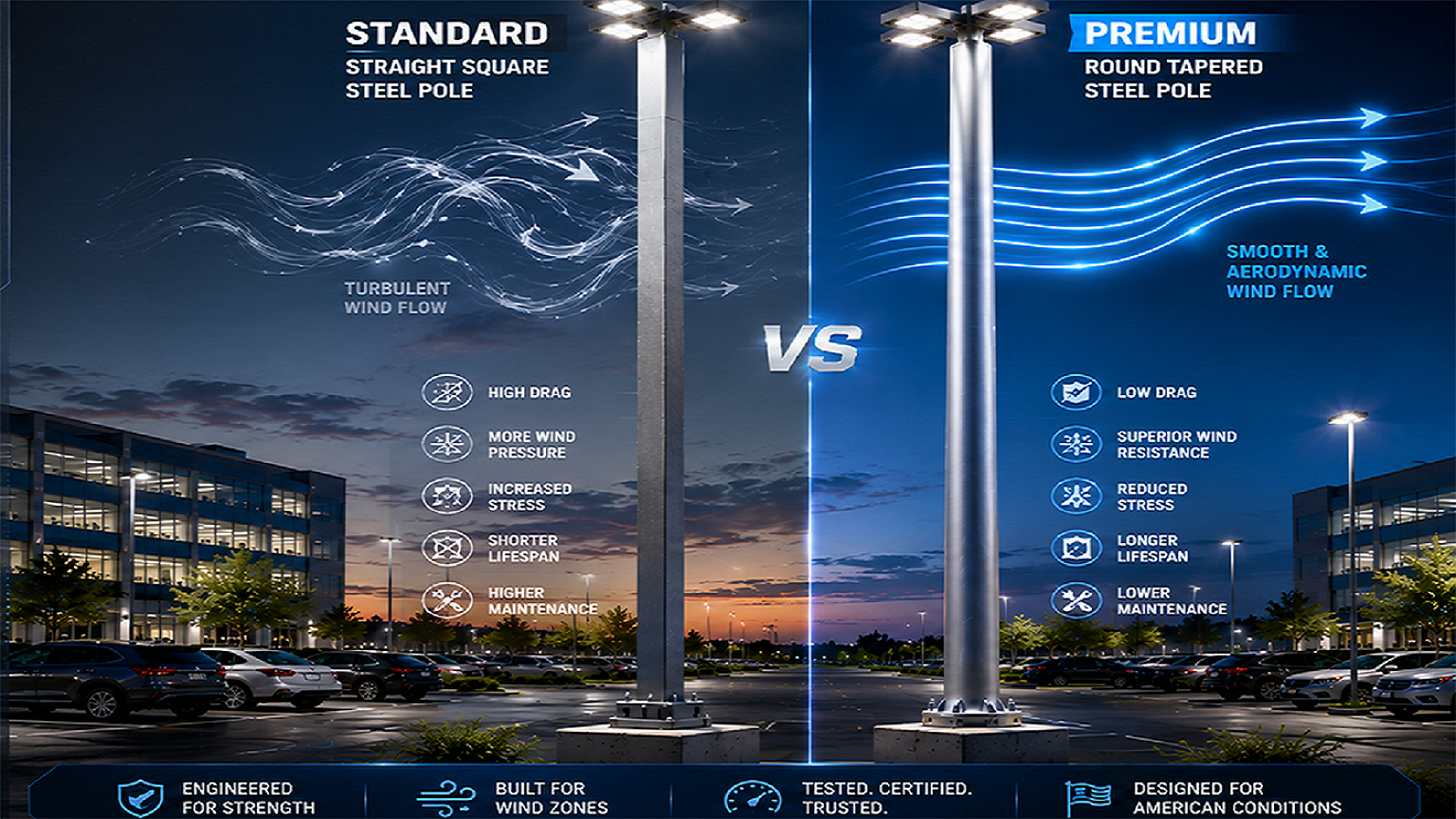
Straight vs. Tapered Light Poles: Which Offers Better Structural Integrity?
 June 9, 2026
 -
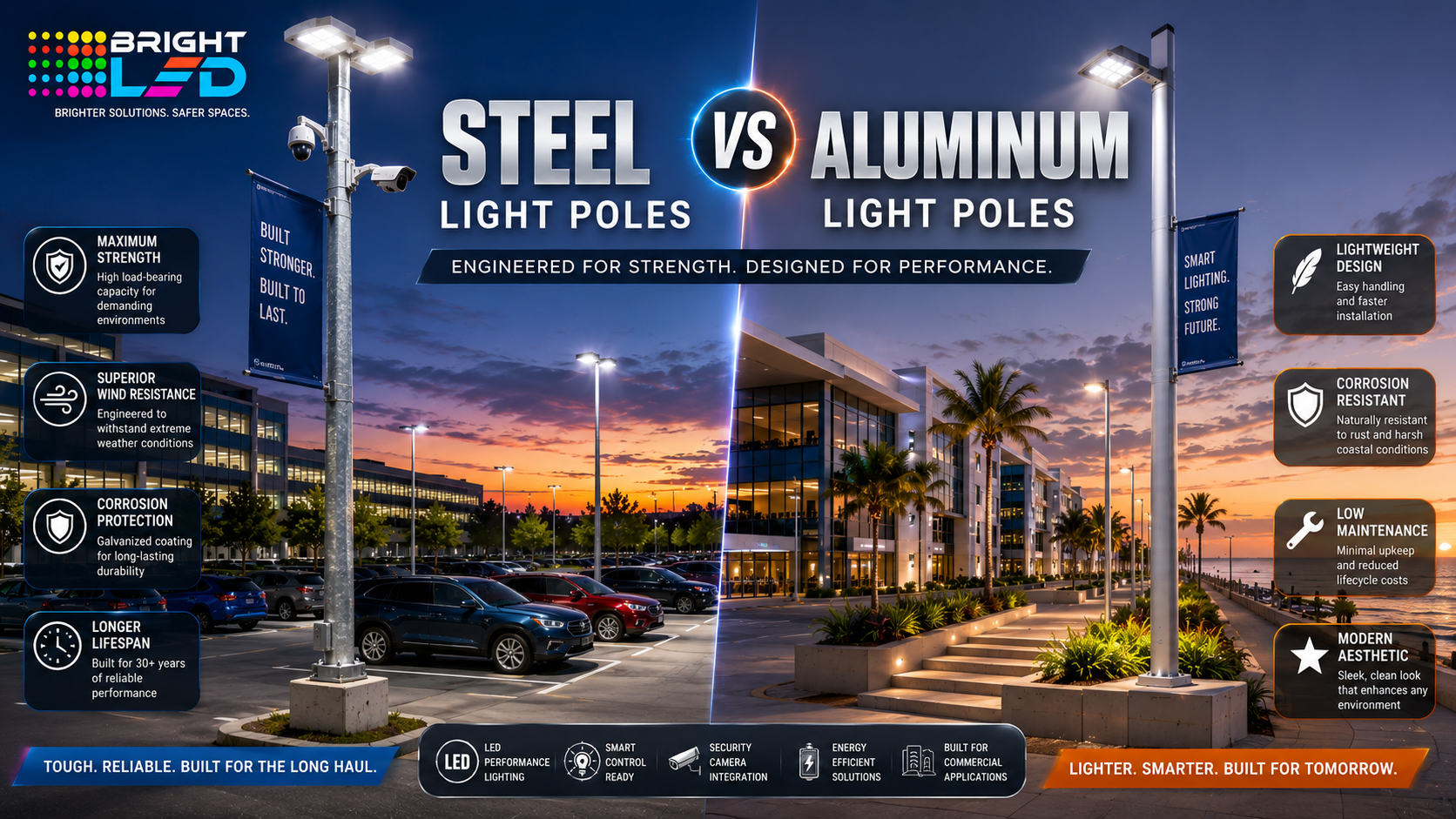
How to Choose the Right Commercial Light Pole: Steel vs. Aluminum
 June 5, 2026
 -
Best Practices for Specifying Round Steel Poles for Commercial Parking Lots
 June 2, 2026
 -
LED Emergency Exit Signs: Installation Guide for Commercial Buildings (2026)
 May 26, 2026
 -
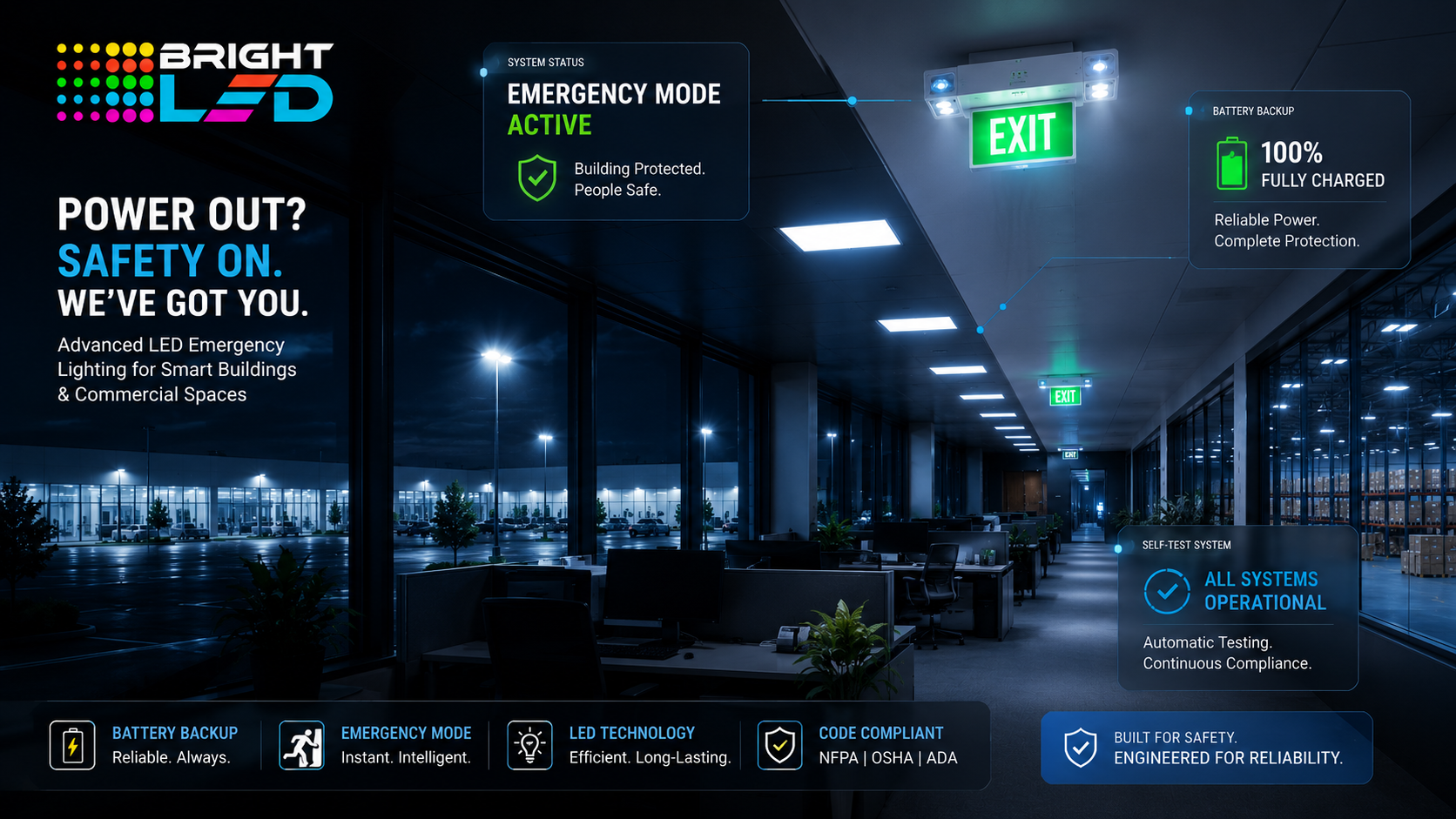
LED Emergency Battery Backup Systems for Commercial Lighting & Businesses
 May 23, 2026