
Emergency Exit Sign Requirements in the USA: Codes Explained Simply
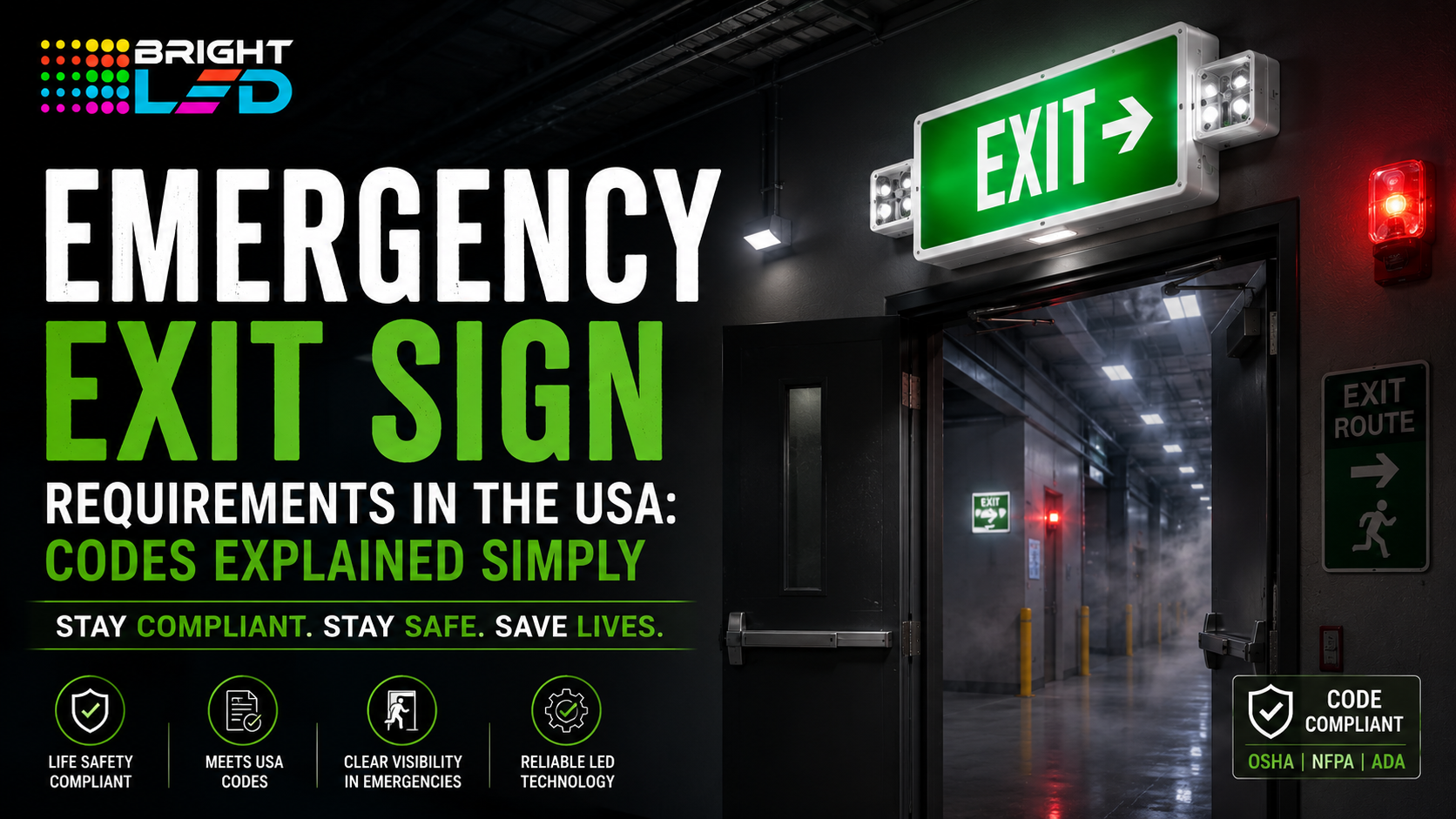
Emergency Exit Sign Requirements in the USA: Codes Explained Simply
A workplace in an emergency state will not be a workplace anymore. In case of a blackout, fire, or other emergencies, the difference between a safe and an unsafe escape route will often come down to one thing only: an exit sign like LED Exit Combo.
The following aspects should be considered by entrepreneurs, facility managers, or property developers who want to make sure their premises meet the 2026 standards. Emergency exit sign requirements include both legal considerations and insurance policies, as well as life and safety regulations. Although the number of codes from OSHA, NFPA, and ADA may seem intimidating at first, they all share a common logic: they aim at visibility, durability, and accessibility.
This article provides you with an overview of the basic requirements for emergency signs in the United States.
The Big Three: Who Sets the Rules?
There is no single organization responsible for emergency signs in the USA. Three main organizations cooperate to ensure maximum security and safety of workers in any workplace:
- OSHA (Occupational Safety and Health Administration): Is concerned about the safety of workers' lives. Its main task is making sure workers can leave the building safely and without getting lost.
- NFPA (National Fire Protection Association): Specifically, NFPA 101:Life Safety Code. This is the best practice standard when it comes to functionality, placement, and maintenance of the signs.
- ADA (Americans with Disabilities Act): The egress path is clear enough so that all individuals, even those with disabilities, can access the exits safely. This means some additional elements should be used, such as Braille inscriptions and a specific mounting height.
Visual Requirements: The "Six-Inch" Standard
For any standard Twin Head Indoor Emergency setup. The most basic requirement for an exit sign is that it must be readable from a distance, even though light smoke or during a total blackout. To ensure this, the codes are very specific about the design of the word "EXIT".
Lettering and Dimensions
As per OSHA and NFPA 101, the inscription "EXIT" must be in easily readable, uppercase letters. In addition, the letters must have a minimum size of 6 inches (15.2 cm). Finally, "stroke width" must be not less than 3/4 of an inch (1.9 cm) wide.
Contrast and Color
It is well known that there is much discussion about whether red or green is better for exit signs; however, the federal government does not prefer any colors and places emphasis on contrast only. If the sign is painted red or LED Exit Sign dual color then usually a white or silver background is needed to achieve maximum readability. Some local authorities (Chicago or NYC) might require some special colors—you should check it out with your fire marshal.
Illumination: Fighting the Darkness
It makes no sense to call a sign that you can’t see at night an emergency sign; it will just be a picture hanging on a wall. The illumination of all the signs that indicate exit routes is mandatory, and in 2026, it is possible to do this in three principal ways:
● Internal Illumination: This is what the majority use today. They are connected to the electricity in the building and have an internal light source (LEDs).
● External Illumination: The traditional sign that uses the light from a specially designed light source placed in close proximity to the sign.
● Photoluminescent (Glow-in-the-Dark): The signs that use natural light to be “charged.” This method is often chosen as they don’t need wiring. However, it should be ensured that there is enough light in the daytime so that they can “charge” themselves up.
The 90-Minute Rule
No matter what technology the signs employ, all of them require a secondary energy source (battery or an emergency generator like UFO Emergency Driver) to work when the main electricity goes out. Such a sign needs to provide its illumination for at least 90 minutes in case of an emergency. This is the time allotted by the NFPA for a complete and orderly evacuation of even the largest structures.
Strategic Placement: Marking the Path
Where you put the sign is just as important as what the sign says. The goal of a "Means of Egress" (the technical term for a path out of a building) is to create a continuous, unobstructed chain of information.
Above the Door
Each door that leads to an exit must have an overhead or adjacent sign. If there is a door that can be easily confused with an exit, such as a closet or basement storeroom, but is not in fact an exit, then a sign stating "NOT AN EXIT" or the real purpose of the door should be present.
Directional Arrows
Signs are required in any case where the exit route is not readily apparent, for example, when traveling along a corridor and needing to make a turn to reach the exit. It should be impossible for anyone to have to guess their direction of travel. When properly designed, the route to the exit will allow for the immediate sighting of a new sign after passing one that has already been reached.
Mounting Height
Illuminated signs should be placed overhead on the door with the bottom of the sign at a height of no more than 80 inches. However, as of 2026, "low level" exit signs are being installed in many modern buildings specially in Commercial Office, and Other public places. These signs are placed at about six inches above the floor, since smoke tends to rise in fires, covering the overhead sign but leaving the air close to the floor clear.
The ADA Factor: Ensuring Accessibility
The ADA requires that exit signs serve more than just the sighted public. It is only when a building incorporates tactile signs that it will become compliant.
● Braille and Raised Characters: Permanent room signs and exit door signs should display Grade 2 Braille and raised letters.
● Tactile Placement: It is not advisable to hang such signs over the door. It is advisable to install these signs on the wall at the latch side of the door. This allows someone with a visual impairment to find the sign at a consistent height (usually between 48 and 60 inches) and "read" it by touch without being hit by a door opening toward them.
Maintenance: The ROI of Readiness
Installing the signs is only half the battle. If a battery dies or a bulb burns out, your compliance disappears instantly. The NFPA mandates a strict testing schedule that every business owner should follow:
- The Monthly Test: On a monthly basis, the "30-second test" should be performed by activating the test switch on the unit to confirm that the battery charges up and the lights stay on.
- The Annual Test: Once per year, emergency lighting should be tested over 90 minutes to simulate a situation where there could be a long power outage. This confirms whether the battery can still hold enough charge to meet the mandate.
Keeping a written log of these tests is vital. During a fire inspection, the marshal won't just look at your signs; they will ask to see your maintenance records.
Common Compliance Mistakes to Avoid
As much as one may be committed to being compliant, there are several compliance traps that businesses tend to fall into. In 2026, these were the mistakes made:
● Blocked Visibility: Putting up decorations and signage as well as storing inventory in such a way as to obstruct the exit sign visible in the hallway.
● The "Shadow" Effect: Putting up a very bright, decorative neon sign, such as an "Open" sign next to an exit sign.
● Mixing Colors: Using red signs on one floor and green signs on another. While both are legal, consistency is key to preventing confusion.
● Neglecting the "Not an Exit" Signs: Failing to mark a dangerous area, like a boiler room, can lead to people trapping themselves during an evacuation.
Conclusion
The tricky subject of the requirements for emergency exit signs need not cause legal headaches for anyone. When all the jargon is stripped away, there are only three things the codes are calling for: Make it large, make it visible, and make it easy to see.
When you follow these requirements, you do more than avoid a fine from OSHA and a citation from the fire marshal. You create something more important than that: you protect what matters most to your company — its people. Properly marking the exit routes in your facility creates a safe place for your clients and employees.
Are your exit signs properly marked? Take a walk around your building and check to see if your "Test" buttons are working.
FAQs
Do I need an exit sign for every door in my business?
That depends on which doors are included in the means of egress (the defined path to safety). But doors that appear to be exits when, in reality, they lead only to hazardous areas (like a storeroom) should be clearly marked as "Not an Exit."
What is the penalty for having non-compliant exit signs?
Fines differ by state but can be more than $15,000 for each violation under OSHA for severe breaches. Besides governmental fines, a breach can mean huge legal ramifications in the event of an accident and could even cause your insurance company to void your policy should any fire damage occur.
How often do I need to replace the batteries in my exit signs?
Although conducting the once-a-month 30-second test and yearly 90-minute test will indicate a failing battery, the typical lifespan of emergency batteries (normally Ni-Cd or lead-acid type) is 5 to 7 years. By 2026, the majority of emergency batteries are going to be of the lithium iron phosphate (LiFePO₄) type, with a potential lifespan of 10 years and better temperature tolerance.


-
Straight vs. Tapered Light Poles: Which Offers Better Structural Integrity?
 June 9, 2026
 -
How to Choose the Right Commercial Light Pole: Steel vs. Aluminum
 June 5, 2026
 -
Best Practices for Specifying Round Steel Poles for Commercial Parking Lots
 June 2, 2026
 -
LED Emergency Exit Signs: Installation Guide for Commercial Buildings (2026)
 May 26, 2026
 -
LED Emergency Battery Backup Systems for Commercial Lighting & Businesses
 May 23, 2026