
How to Choose the Right Commercial Light Pole: Steel vs. Aluminum
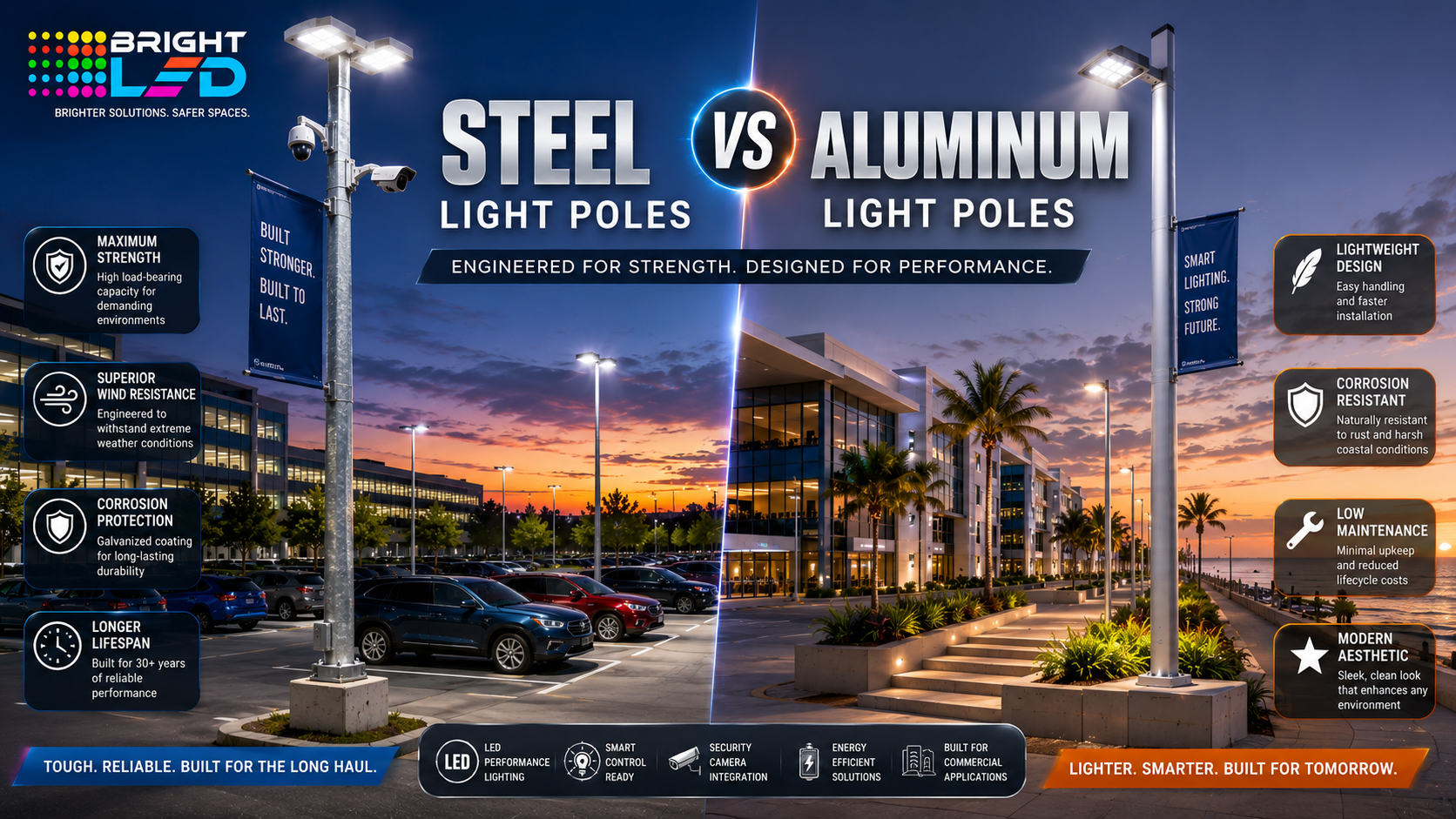
How to Choose the Right Commercial Light Pole: Steel vs. Aluminum
During the process of designing an exterior lighting installation for a commercial building, an office park, or any retail complex, many individuals find themselves becoming mired in the complications of lighting fixtures. Managers analyze the lumens, color rendering index, and efficiency of light-emitting diodes for days. However, what guarantees that the structure will survive long enough to function is its pole.
Making a choice between the materials for your commercial light poles can determine the budget, structural safety, ease of maintenance, and longevity of your project. Although several different materials are offered on the market today, the most important industry discussion inevitably revolves around two strong competitors – steel and aluminum.
There are many differences in terms of their physical, chemical, and mechanical properties. The wrong choice may cause damage to the structure, too much sway when it is windy, and increase costs. Now, let us consider both materials and select the best one for your commercial project.
1. Structural Strength and Load Capacity
The primary job of a light pole is to stand completely upright while holding heavy equipment against the relentless lateral forces of the wind. When evaluating raw structural strength, steel is the undisputed heavyweight champion.
The Steel Advantage
First of all, structural steel possesses higher tensile strength and yield point compared to aluminum. This makes steel an ideal material for Commercial Parking Lot Lighting projects where tall poles and heavy lighting fixtures are required. You will need steel if you require round tapered Steel high-mast poles (about 25 to 40+ feet in height) or have to bear weight of multiple huge floodlights, brackets, security cameras, banners, etc.
Deflection and Wind Sway
Steel is highly rigid. Under intense wind loads, a steel pole will experience minimal deflection (the physical distance the pole bends away from its vertical center axis). Controlling sway is critical because excessive movement creates a distracting "strobe effect" on the pavement below as the light beam shifts, while putting undue mechanical stress on the internal electronics of your LED fixtures.
2. Corrosion Resistance and Environmental Adaptability
As much as steel triumphs in terms of pure strength, aluminum outclasses it in resisting environmental pollution and corrosion.
The Aluminum Self-Defense Mechanism
Speaking of anti-corrosive properties, aluminum does not have any iron content (hence its name). Despite that the oxidation occurs as a result of the interaction of aluminum with oxygen and water, iron does not come into play; therefore, there is no iron oxide – or rust. In other words, aluminum oxide creates a barrier from the process of oxidation.
The Vulnerability of Steel
Unlike aluminum, iron is a constituent of steel, hence making it highly susceptible to rust formation in the absence of proper protection. For commercial steel posts to be usable outdoors, they must go through elaborate processes like hot-dipping (immersing steel in zinc) and multiple rounds of powder coating. Once rust gets a foothold after a scratch from any item such as a lawnmower, bicycle chain, or flying pebbles, it will start corroding the metal underneath the paint.
3. Weight, Transport, and Installation Logistics
Physical mass becomes very significant concerning the costs of logistics within a commercial development project.
● Lower Freight Costs: Because aluminum poles are lightweight—roughly one-third the weight of structural steel—more units can be packed onto a single delivery truck, reducing shipping costs over long distances.
● Simplified On-Site Handling: Installing a heavy steel pole requires heavy-duty cranes, extensive rigging, and a large installation crew to lift and secure the shaft onto its concrete foundation. An aluminum pole, especially at standard pedestrian heights (10 to 15 feet), can often be lifted and positioned manually or with light, less expensive equipment, lowering on-site labor expenses.
4. Passive Safety and Vehicular Impact Compliance
The probability that a vehicle might collide with a light pole in areas with large traffic volumes such as busy roads, municipal roads, and airport parking lots is indeed a significant hazard.
For aluminum poles, there exists one particular attribute of safety inherent in these types of materials called frangibility. This term describes the tendency for light material, such as aluminum that is much lighter than structural steel, which can be combined with engineered breakaway or slip bases.
With a breakaway aluminum pole hit by a fast-moving vehicle, the pole snaps completely at the base plate, which makes use of the reduced weight of the pole to enable the force of impact to move the pole upward and away from the vehicle's cabin without abrupt stops like the forceful collision with a steel pole, which would result in much lower absorption of the energy of impact.
5. Aesthetics and Architectural Finishes
Appearance plays a role in making your commercial property attractive, and both materials can be designed to suit any architectural theme. Mostly used in commercial parking lots lighting.
Anodized Aluminum
Aluminum poles may be subjected to the anodizing procedure. In contrast to paint coating, anodizing involves the conversion of the metal surface into a durable and porous layer capable of soaking a special dye. As a result, the surface receives a beautiful metallic finish, such as satin clear, bronze, or black, which will not chip, flake off, nor rust. Such poles will keep their attractive appearance for many years.
Industrial Powder Coatings
Steel poles are typically finished with a high-durability powder coat over a galvanized primer base. This duplex system provides a thick, protective color coating that can match any corporate branding color or municipal code requirement. At the same time, steel poles, coated with powder paint, will require regular inspections to detect surface chips and avoid rust penetration and damage to the steel underneath.
6. Sourcing Summary: Matching Material to Application
● Ideal Height Range: Steel handles 20 to 100+ feet easily (excellent for high-mast arrays). Aluminum is ideal for 8 to 25 feet footprints (excellent for pedestrian-scale landscaping).
● Corrosion Protection: Steel requires hot-dip galvanizing or heavy exterior powder coating. Aluminum is naturally rust-resistant when left bare, anodized, or painted.
● Structural Mass: Steel is heavy and provides high structural stability. Aluminum is lightweight, leading to easy on-site installation and lower transit logistics costs.
● Wind Resistance: Steel offers outstanding rigidity and minimal structural sway. Aluminum shows moderate flexibility and requires careful Effective Projected Area (EPA) matching.
● Best Geographic Use: Steel performs brilliantly in inland regions and low-humidity zones. Aluminum is the premium pick for coastal boardwalks, wet climates, and high-salinity road-salt zones.
Conclusion
It follows that several crucial factors should be taken into consideration while choosing between steel and aluminum poles for a specific commercial building. It goes without saying that the latter will definitely be chosen in cases when there is a need for high load bearing at high altitudes, in which case quality of construction is not in question. However, the need to use aluminum poles arises under conditions of high salinity or extremely cold regions that make heavy use of deicing agents.
Therefore, by evaluating the specific wind conditions, architectural objectives, and maintenance capabilities, one can provide their commercial property with a perfect lighting system.
FAQs
Which material is more cost-effective for a standard commercial project?
On a pure material basis, steel poles are generally cheaper to purchase upfront than aluminum poles due to lower raw material costs. However, when you factor in the long-term savings of aluminum—such as lower shipping fees, reduced installation equipment costs, and zero rust-maintenance expenses over a 30-year lifespan—aluminum often delivers a lower total cost of ownership for standard pedestrian-scale applications.
Can I use aluminum poles in hurricane-prone coastal regions?
Yes, but you must carefully analyze the pole's wall thickness and Effective Projected Area (EPA) wind load rating. Because aluminum is more flexible than steel, you may need to specify an aluminum pole with a thicker gauge or a larger diameter to ensure it can withstand localized design wind speeds without excessive deflection.
How long do commercial steel vs. aluminum poles typically last?
An anodized aluminum pole can easily last 40 to 50+ years with virtually zero structural degradation, even in harsh coastal climates. A properly hot-dip galvanized steel pole can match that lifespan in standard environments, but its longevity drops if its protective zinc coating is structurally damaged or compromised.


-
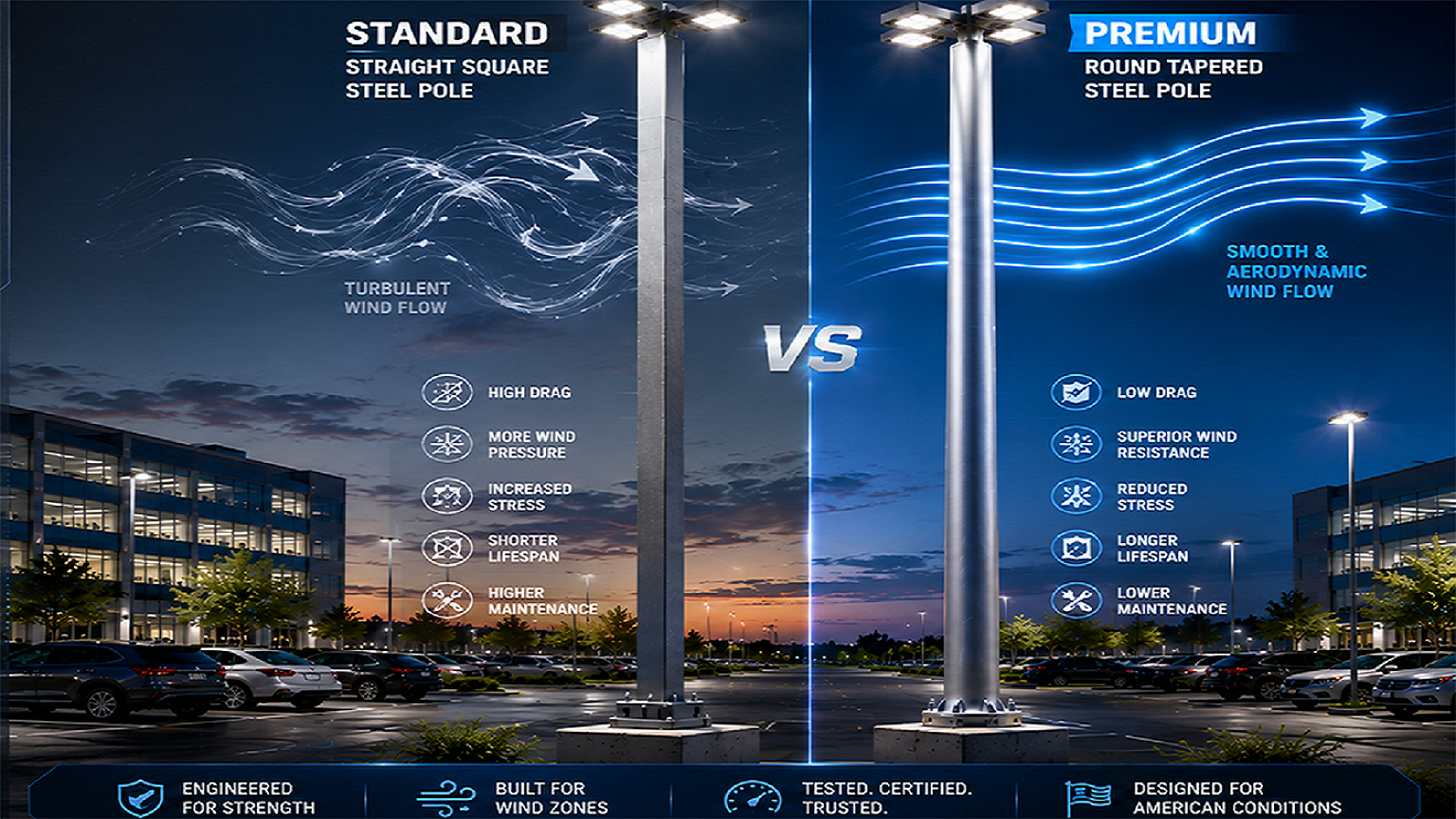
Straight vs. Tapered Light Poles: Which Offers Better Structural Integrity?
 June 9, 2026
 -
How to Choose the Right Commercial Light Pole: Steel vs. Aluminum
June 5, 2026
-
Best Practices for Specifying Round Steel Poles for Commercial Parking Lots
 June 2, 2026
 -
LED Emergency Exit Signs: Installation Guide for Commercial Buildings (2026)
 May 26, 2026
 -
LED Emergency Battery Backup Systems for Commercial Lighting & Businesses
 May 23, 2026