
Best Practices for Specifying Round Steel Poles for Commercial Parking Lots
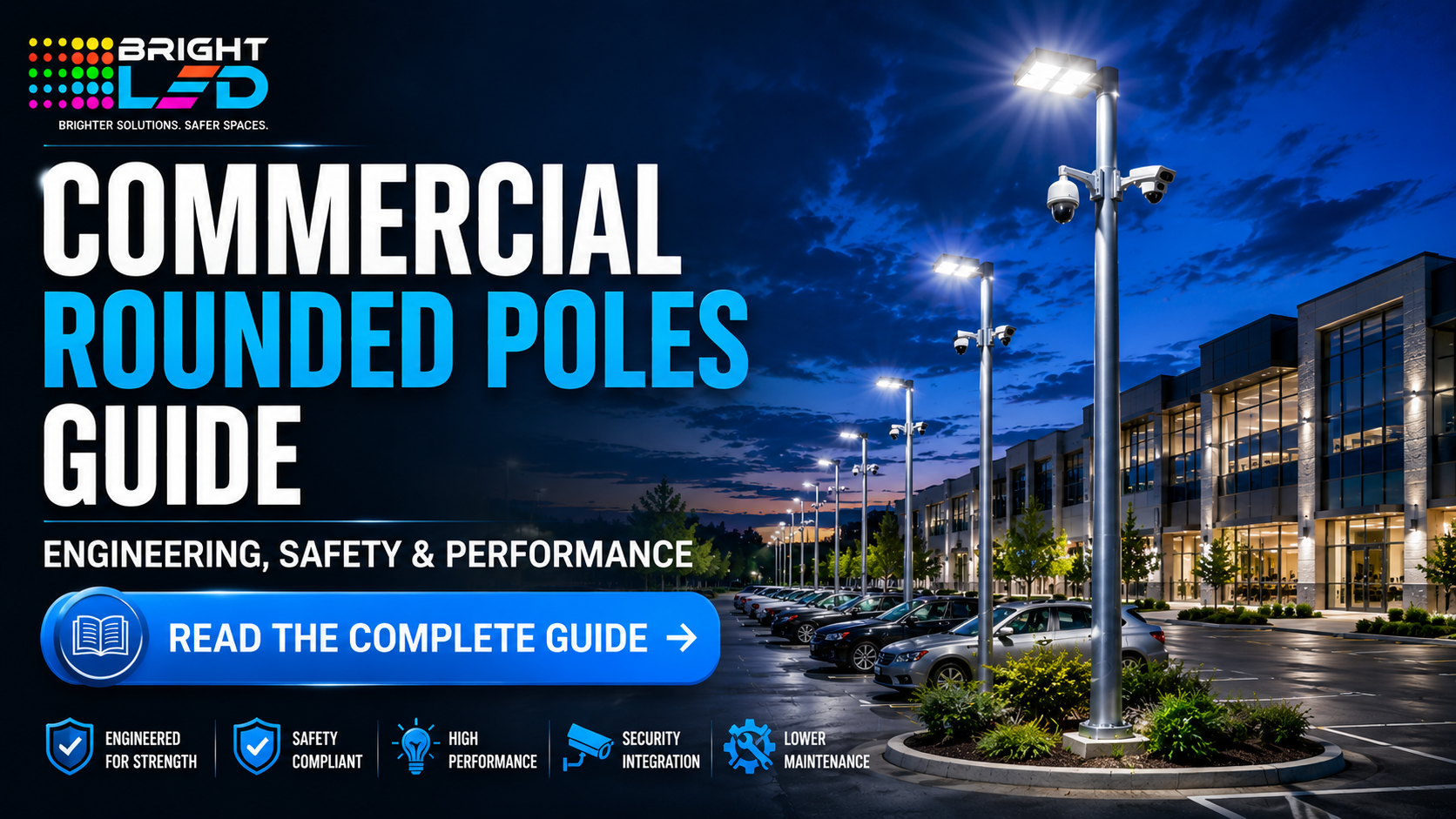
Best Practices for Specifying Round Steel Poles for Commercial Parking Lots
As regards the design of a parking area, lighting is mostly thought about when it comes to fixture choice, where countless hours are spent trying to figure out which lumens, color temperatures, and distributions work well together, whereas the actual architectural pieces, used to host such fixtures, are considered secondarily. It is very important not to make that mistake. Indeed, proper structural support is essential to make your property stand tall and proud.
For owners, developers, and engineers, there can be no better choice than specifying rounded poles made from high-tensile steel. These provide amazing combinations of rigidity and elegance. Yet, making wrong specifications could result in structural failure, sway, and wind damage.
In order to make sure your structure will last for years to come, we have compiled a list of the basics when specifying rounded steel poles for commercial areas.
1. Calculating the True Structural Load: EPA and Weight
The absolute most critical step in specifying any steel pole is calculating the total load it will bear. In engineering terms, this is determined by two main factors: weight and Effective Projected Area (EPA).
What is EPA?
EPA is an aerodynamic measurement that calculates how much wind resistance a lighting fixture or any attached bracket creates. It is not just about physical size; a large, flat floodlight will have a much higher EPA than a sleek, low-profile, LED shoe-box fixture.
The Formula for Safety
Every round steel pole has a maximum EPA rating determined by the manufacturer, which varies based on regional wind speeds. When specifying your pole, you must calculate the combined EPAs and weight of:
● The primary lighting fixtures.
● All mountings, bullhorns, or cross-arms.
● All add-ons, including security cameras, Wi-Fi repeaters, or banners.
When the combined weight of the additional attachments is larger than the EPA allowed by the pole for the region where you are located, wind loads may create structural fatigue, cracking at welded joints, or even complete failure.
2. Navigating Regional Wind Speeds and Gust Factors
A pole that is perfectly safe for a commercial parking lot in a low-wind inland valley will quickly fail if installed along a hurricane-prone coastline.
ASCE 7 Design Standards
Engineers refer to ASCE 7 maps in order to figure out the maximum wind speeds expected at certain locations. According to these maps, minimum structure strength requirements are established. When specifying commercial rounded poles, always look at the local wind map requirements rather than guessing.
The Importance of Gust Factors
Wind blows in gusts, not as a smooth flow of air. Modern engineering guidelines should take into account the gust factor due to the lack of surrounding buildings and trees that could weaken the gust effect in open areas like commercial parking lots. Always specify a pole rated for the maximum localized wind speed plus the required safety factor.
3. Structural Advantages of Round vs. Square Poles
While square poles are common in modern commercial developments, round steel poles offer unique mechanical advantages that make them a superior choice for many parking lot layouts.
Wind Resistance
The wind flows around the round object in a laminar mode, which results in reduced drag force compared to square profiles of equal size since the square profile creates drag similar to that of a sail.
Stress Distribution
Round steel poles distribute environmental loads uniformly across their entire perimeter. They lack the weak corners or concentrated stress points found along the welded longitudinal seams of square steel models.
Aesthetic Appeal
Not only is there less wind load, but round columns also give a classic, softer architectural appearance that complements different types of landscape architecture without the harsh appearance created by square designs. As a result, this can enable you to use a pole with a thinner wall or a smaller diameter but the same safety ratings, thereby saving on materials.
4. Selecting the Right Wall Thickness and Diameter
Steel strength is fundamentally governed by its geometry. Two measurements will determine the strength of any commercially available rounded pole in terms of physics. The first is the diameter, and the second is the gauge or the wall thickness.
Finding the Right Gauge
In cases where light-duty applications are involved that do not exceed heights of between 15 and 20 feet, an 11-gauge wall thickness measuring at least 0.120 inches will suffice for LED lights. However, when mounting LED lights on higher posts or stacking many lights on one pole, a thicker 7-gauge steel measuring 0.180 inches is recommended.
Deflection and Sway
Thinner walls allow for more deflection, which is the amount the pole bends under a gust of wind. While steel is designed to flex slightly, excessive sway causes a highly distracting "strobe effect" on the parking lot surface as the light fixtures move. It also puts undue stress on the driver components inside your LED fixtures, shortening their operational lifespan.
5. Corrosion Prevention: Weatherproofing the Investment
Steel’s greatest enemy is moisture. Because parking lot poles are completely exposed to the elements, specifying the right finish is the difference between a 30-year lifespan and a pole that rusts out at the base within a decade.
Hot-Dip Galvanizing (HDG)
For optimum life expectancy, nothing beats hot-dip galvanizing. In this type of galvanizing, the entire fabricated steel pole is dipped into the zinc metal bath. Zinc reacts chemically with the steel metal and forms several layers of protective coating on both the inner and outer surfaces of the pole. Thus, even if the pole is damaged and the zinc coating on the outer surface is compromised, the inner layer still prevents rusting.
Multi-Stage Powder Coating
When you want a certain aesthetic for your commercial property (dark bronze, black, or green) then look out for posts that employ a double-coating system. This includes a powder-coating topcoat with an undercoat of galvanized metal primer. Thus, you get the protection of the zinc metal against corrosion together with the UV-resistance of the powder coat.
6. Vibration and Harmonics: The Hidden Danger
One of the dangers in commercial parking lot lighting designs that is often ignored is the first and second mode vibrations.
Wind-Induced Vibration
In open commercial parking lots, stable and slow-moving wind may generate a phenomenon known as aeolian vibration. This results from the formation of alternating vortices along the two sides of a circular pole. This vibration occurs when the frequency of the vortex generation coincides with the natural frequency of the pole.
Specifying Dampeners
This issue is especially common in straight, slender, round poles that lack heavy fixture loads to disrupt the resonance. To mitigate this, look for manufacturers who offer internal factory-installed vibration dampeners. These simple devices (often a weighted rod or chain suspended inside the pole) absorb kinetic energy and disrupt harmful harmonic frequencies before they can cause structural fatigue at the base weld or handhole.
7. Handhole Accessibility and Grounding Best Practices
The physical installation and ongoing maintenance of the electrical wiring require careful structural design choices at the lower portion of the pole.
● Reinforced Handholes: Every steel pole must feature a handhole near the base to allow electricians to wire the fixtures. Because cutting a hole into a tube inherently weakens that specific section, the handhole must be reinforced with a heavy steel frame welded in place to maintain the pole's structural rating.
● Secure Grounding: Safety codes require that all steel poles be properly grounded to protect pedestrians and service technicians from electrical shocks in the event of a wiring short. Ensure your specification includes a dedicated copper grounding lug located inside the handhole frame for easy access.
Conclusion
Specifying the right commercial rounded poles is a foundational step in building a safe, resilient, and visually appealing parking lot infrastructure. By balancing the mathematical realities of weight and EPA against regional wind conditions and protecting the structure with high-quality finishes, you ensure that your facility lighting remains reliable for decades to come. Don't leave your site safety up to guesswork—work closely with qualified structural engineers and trusted manufacturers to verify every specification before the first anchor bolt is poured.
FAQs
What is the ideal pole height for a standard commercial parking lot?
For most retail and commercial lots, a pole height of 20 to 25 feet offers the best balance of light spread and cost efficiency. Warehouses and large logistical hubs often specify 30 to 40-foot poles to reduce the total number of poles needed over a massive footprint.
Can I attach security cameras to standard commercial rounded poles?
Yes, but you must factor in the weight, wind profile (EPA), and potential vibration caused by the camera. Furthermore, camera wires should be run through a separate internal conduit from the high-voltage lighting wires to prevent signal interference.
Are anchor-base or direct-burial steel poles better for commercial lots?
Anchor-base poles (bolted to a poured concrete foundation) are the industry standard for commercial parking lots. They offer far superior structural stability and allow the pole to be leveled or replaced easily if damaged by a vehicle collision.


-
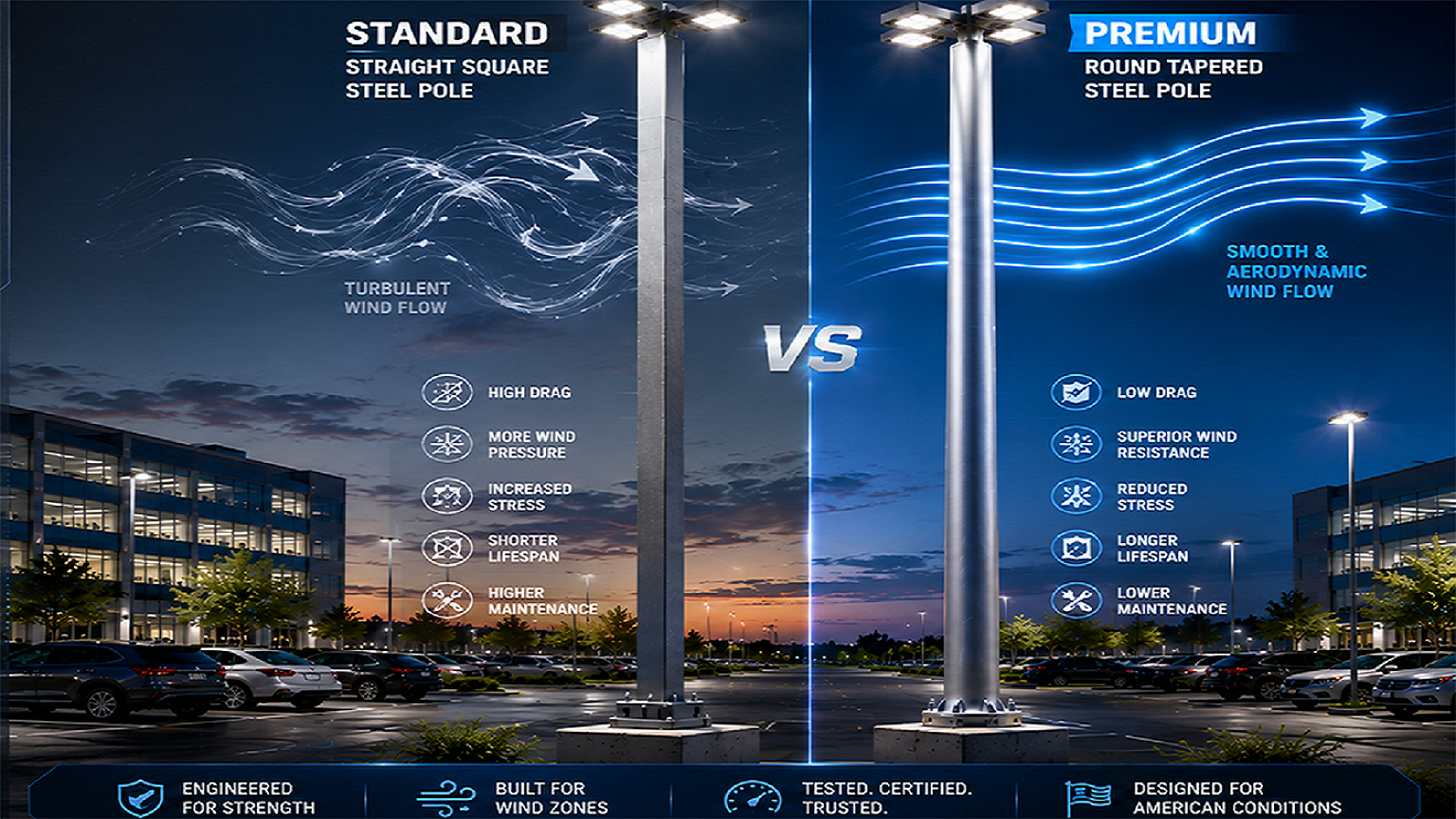
Straight vs. Tapered Light Poles: Which Offers Better Structural Integrity?
 June 9, 2026
 -
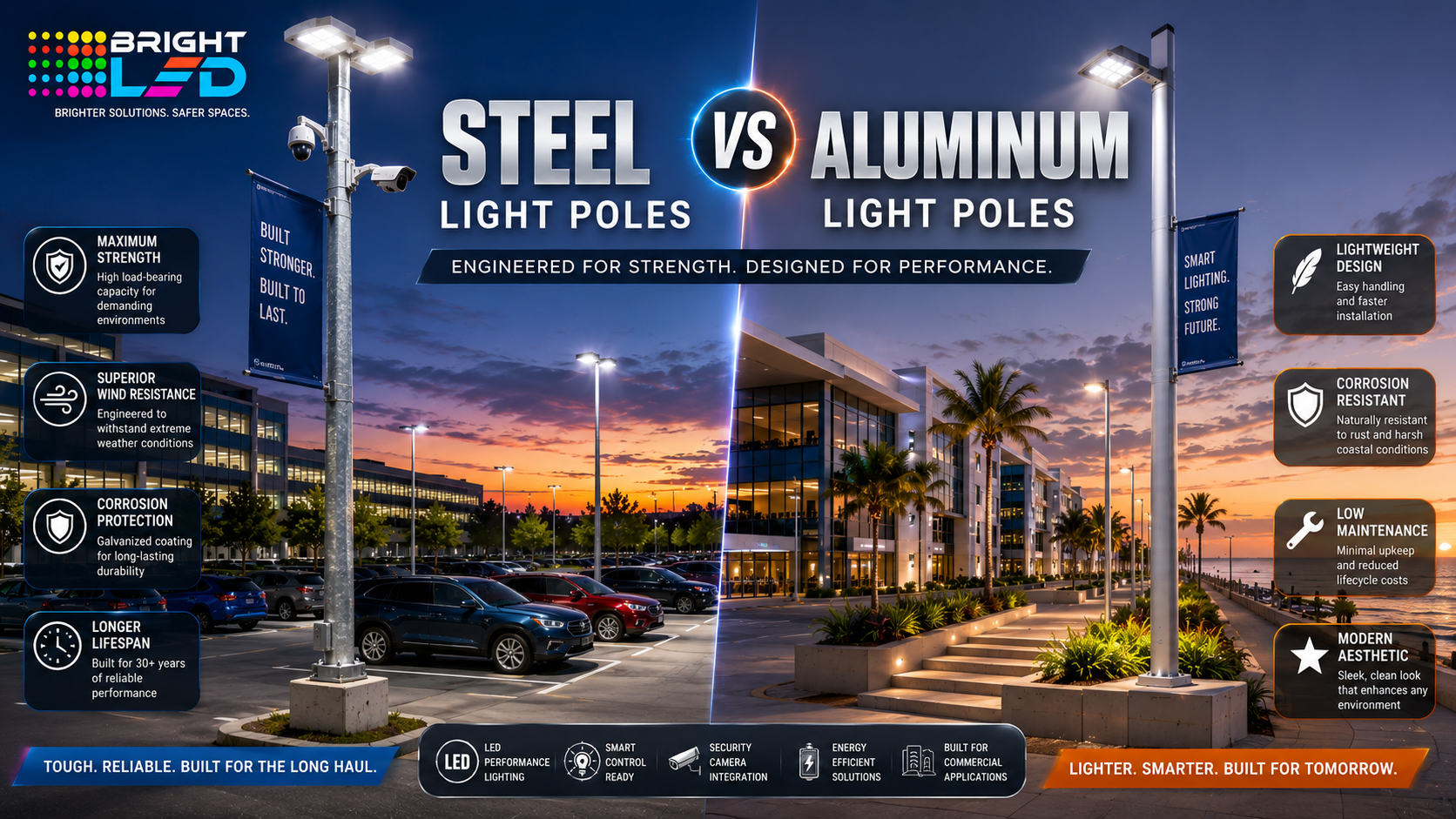
How to Choose the Right Commercial Light Pole: Steel vs. Aluminum
 June 5, 2026
 -
Best Practices for Specifying Round Steel Poles for Commercial Parking Lots
June 2, 2026
-
LED Emergency Exit Signs: Installation Guide for Commercial Buildings (2026)
 May 26, 2026
 -
LED Emergency Battery Backup Systems for Commercial Lighting & Businesses
 May 23, 2026