
Straight vs. Tapered Light Poles: Which Offers Better Structural Integrity?
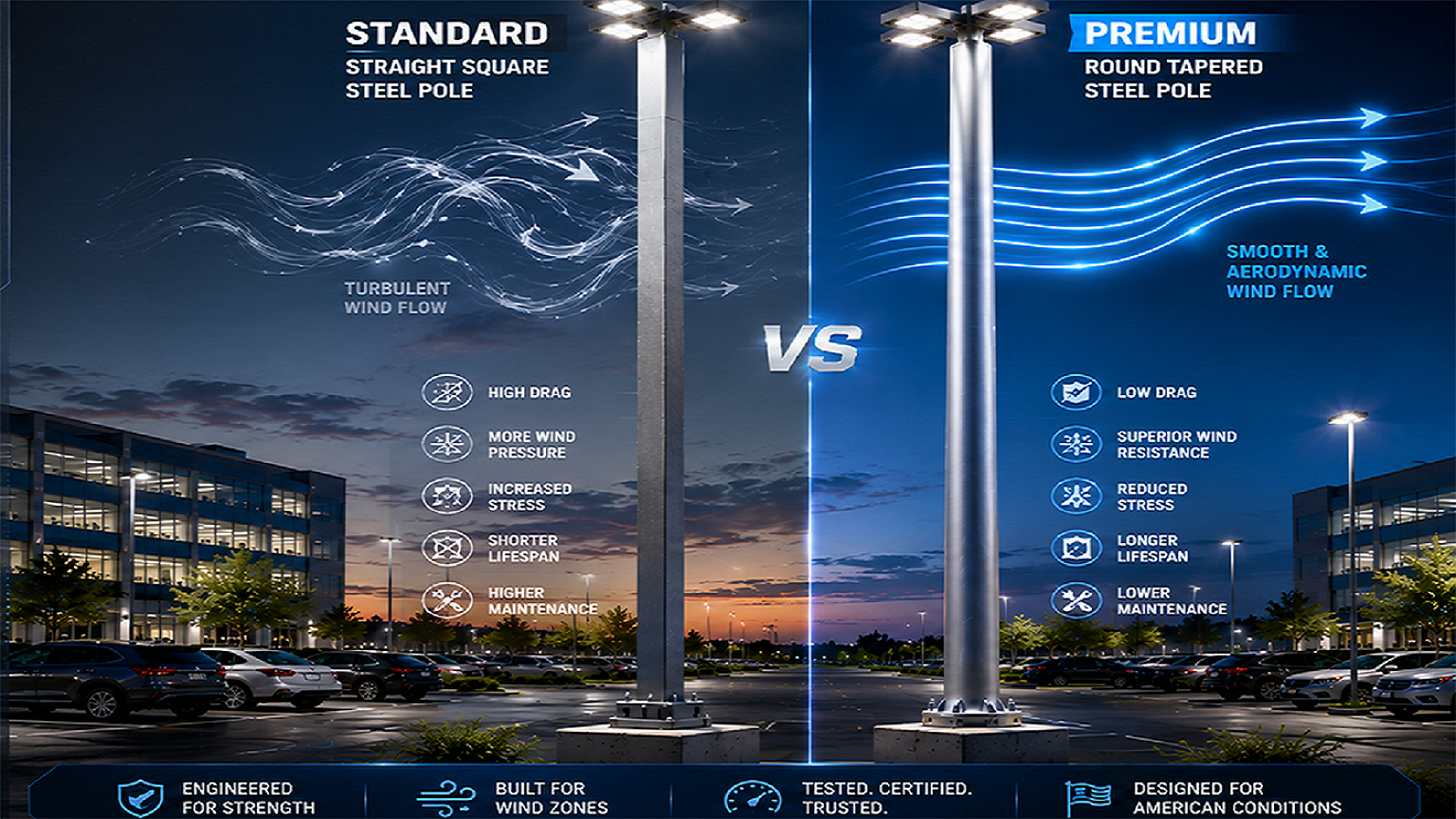
Straight vs. Tapered Light Poles: Which Offers Better Structural Integrity?
In creating an outdoor lighting installation scheme for such locations as parking lots for businesses, corporate campuses, and roadways of municipalities, all attention is paid to light fixtures. Many engineers invest hours into calculations of lumens and photometrics, finding suitable energy-efficient LED lamps for their installations. However, the structural stability and durability of the pole supporting the installation should not be overlooked.
There are a number of factors to consider when designing a lighting pole; however, among all decisions, the choice of either a straight or tapered profile is undoubtedly the most characteristic of any lighting structure. In the case of straight poles, the diameter does not change along the height of a pole. Tapered poles become narrower as the pole rises.
Analyzing these two types of poles based specifically on round tapered steel poles, we can see that in terms of engineering characteristics, one profile clearly stands out from the other. In order to find out what it takes for a pole to be called a structurally superior one, let us compare the mechanical and architectural features of straight and tapered poles.
1. The Physics of Load Distribution and Stress Centers
In order to fully comprehend the significance of pole design in the structure, one needs to delve into the laws of physics behind cantilever structures. A pole can be regarded as an inverted vertical cantilever beam that is secured at the ground level and experiences horizontal forces due to the wind.
Wind blowing against a light fixture and the upper end of the pole results in a bending moment, which acts similarly to a lever. As a result, the greatest amount of stress is accumulated at the very bottom of the pole—where it attaches to the base plate and bolts.
Straight Poles and Wasted Material
Since the pole is perfectly straight, the dimensions of its wall remain constant throughout its entire height, and, consequently, the stress in the upper part of the pole is low. In other words, the excess metal in the upper half of the pole is just extra load, rather than an advantage, mechanically speaking.
Tapered Poles and Natural Geometry
On the other hand, the round tapered steel poles reflect the natural structural strength of a tree trunk by being wider on the bottom where the physical stress would be greatest and narrower on top where the physical stress would be minimal. Such a design ensures the uniform distribution of stress through the shaft without adding any man-made weak spots to steel poles.
2. Managing Wind Resistance and Aerodynamics
Wind is the single greatest threat to outdoor lighting infrastructure. Calculating a pole's ability to survive local wind storms involves analyzing its physical shape alongside the Effective Projected Area (EPA) of the attached fixtures.
Aerodynamics of Round Tapered Shapes
Since a round profile automatically has a smooth surface, it offers low resistance to airflow. When added to the vertically tapered shaft, the round profile results in a very aerodynamic pole.
Due to its gradual decrease in diameter from the bottom up, a tapered pole has less surface area on top. The reduced surface area makes it harder for the wind to affect the lever arm tip because it has less physical mass to work on there.
Regional Wind Map Compliance
In projects where there is a need for installations in hurricane zones and high-wind plains, meeting the requirements of local codes mandates the installation of equipment that is capable of withstanding the heavy loads resulting from strong winds. With the ability of a tapered shaft to resist such heavy winds due to their efficiency in aerodynamics, it is possible to comply with the requirements in high-wind areas without necessarily resorting to heavy steel walls, saving money without compromising on safety. This is particularly critical for commercial roadway street lighting, where safety, reliability, and regulatory compliance are top priorities.
3. Controlling Deflection, Sway, and Structural Fatigue
Deflection is the extent to which a steel light pole deviates from its centerline axis under lateral force. Though deflection may not be a major concern since all steel light poles are supposed to bend easily, extreme cases call for concern.
The Strobe Effect and Driver Failure
Due to a uniform distribution of weight along a straight pole, the upper portion can be swayed by a considerable degree when subjected to a heavy wind. In such a case, there will be a strobe effect caused by the swaying of the beam from side to side, and the vibrations will cause undue damage to the light fittings.
Rigidity of the Tapered Base
Because a tapered pole concentrates its physical mass at the base, it possesses much higher structural rigidity. The wider bottom diameter reduces the overall amplitude of the wind sway. Once the pole starts flexing, the movement is quickly dampened by the design, keeping fragile internal electronics safe and maintaining an even light field over the road surface.
4. Vibration, Harmonics, and Aeolian Resonance
Though major storms are certainly a threat, consistent low-velocity winds can trigger a similarly damaging phenomenon called aeolian vibration or harmonic resonance.
The Danger of Steady Winds
If wind flows steadily over a cylindrical shape, such as a straight pole, it produces alternating vortices above the surface, on either side. If the wind speed corresponds to the natural frequency of vibration for the pole, a resonance effect occurs, and the pole starts vibrating perpendicularly to the direction of the wind flow. Gradual, constant vibrations produce stress fractures at the welded base that lead to the collapse of the structure.
Breaking the Resonance Window
The design of a tapered pole breaks the destructive effect of harmonic resonance. As the diameter of the pole shaft constantly changes throughout its height, vortex patterns generated by the wind become inconsistent. The wind is unable to produce consistent vibration frequencies in the structure, and consequently, any resonance effect is eliminated.
5. Manufacturing, Longevity, and Environmental Protection
The structural integrity of a light pole is also influenced by how it is manufactured and protected from the elements over its operational lifespan.
Structural Grade Steel Fabrications
High-quality tapered poles are typically fabricated by cold-forming structural steel sheets into a precise conical shape, followed by a continuous longitudinal automatic weld. This process ensures uniform wall thickness and material integrity from top to bottom. For a detailed comparison of material options, read our guide on choosing between steel and aluminum light poles.
Weatherproofing the Structure
Because steel is vulnerable to moisture and oxygen, protecting the interior and exterior of the pole shaft is critical to stopping rust before it compromises the metal's thickness.
● Hot-Dip Galvanizing (HDG): Submerging the entire tapered pole into molten zinc ensures that a protective layer coats both the outside and inside of the narrowing shaft, eliminating potential rust spots.
● Duplex Coatings: For premium applications, applying a durable powder coat finish over the galvanized base layer provides excellent UV resistance and aesthetic appeal while reinforcing the underlying corrosion barrier.
6. Practical Comparison for Commercial Applications
● Stress Distribution: Straight steel poles concentrate loads heavily at the base, whereas round tapered steel poles distribute them evenly across the shaft.
● Wind Drag Profile: Straight profiles present a moderate to high wind profile. Tapered designs are highly aerodynamic and feature a low wind drag profile.
● Vibration Resistance: Straight poles remain vulnerable to harmonic resonance. Tapered geometry naturally disrupts vortex shedding to protect the metal from vibration fatigue.
● Deflection/Sway Control: Straight options show a high sway potential at tall heights. Tapered configurations offer excellent rigidity and rapid dampening.
● Visual Architecture: Straight designs provide an industrial, hard angular look. Tapered profiles present a clean, organic, and modern aesthetic.
Conclusion
When evaluating straight versus tapered light poles strictly through the lens of structural engineering, round tapered steel poles emerge as the superior choice for high-demand commercial environments. By placing the maximum material mass at the base where stress forces are concentrated, tapering minimizes top-heavy wind resistance, dampens destructive vibrations, and controls physical sway.
While straight poles retain a clear place in short, low-clearance applications, investing in the natural, optimized geometry of a tapered steel pole ensures your Commercial Parking Lot & Street Lighting system stands secure against the elements for decades to come.
FAQs
Are straight poles ever preferred over tapered poles?
Yes. Straight poles are highly popular for lower mounting heights (10 to 15 feet) where wind loads are minimal and architectural designs call for a sharp, linear look. They are also ideal for tight budget constraints on simple, low-height retail properties.
How does wall thickness impact a tapered pole’s strength?
Wall thickness (typically measured in 7-gauge or 11-gauge steel) directly influences the pole's load capacity. A tapered pole combined with a heavier wall gauge creates a highly durable structure capable of supporting multiple large fixtures, heavy brackets, and security cameras simultaneously.
Do tapered poles require different foundations than straight poles?
The basic anchor bolt installation process is identical. However, because tapered poles are wider at the base, they typically utilize larger bolt circles and base plates, which must be factored into the initial concrete footing pour.


-
Straight vs. Tapered Light Poles: Which Offers Better Structural Integrity?
June 9, 2026
-
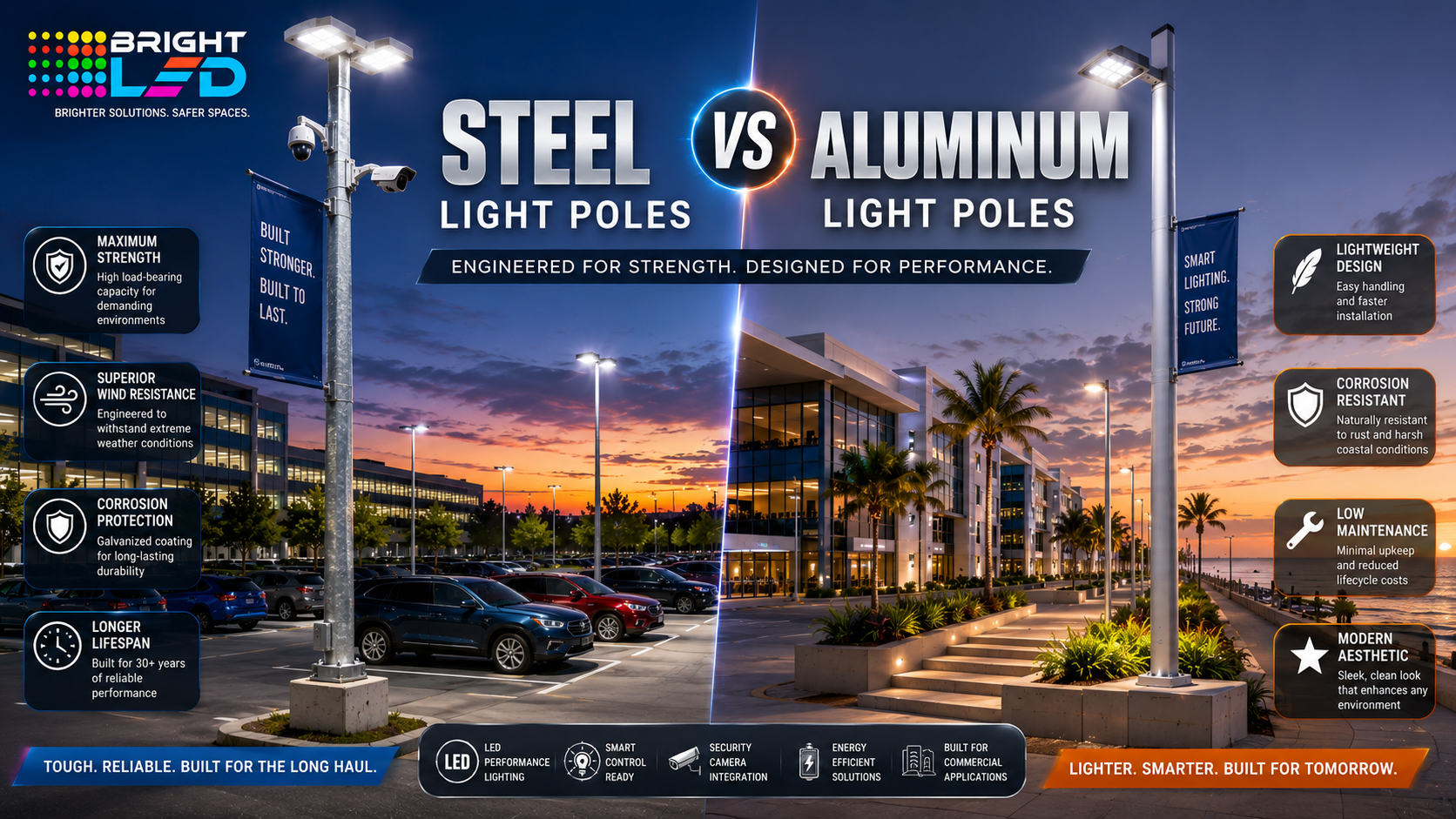
How to Choose the Right Commercial Light Pole: Steel vs. Aluminum
 June 5, 2026
 -
Best Practices for Specifying Round Steel Poles for Commercial Parking Lots
 June 2, 2026
 -
LED Emergency Exit Signs: Installation Guide for Commercial Buildings (2026)
 May 26, 2026
 -
LED Emergency Battery Backup Systems for Commercial Lighting & Businesses
 May 23, 2026