
Cost Comparison - LED Vs Traditional Lighting
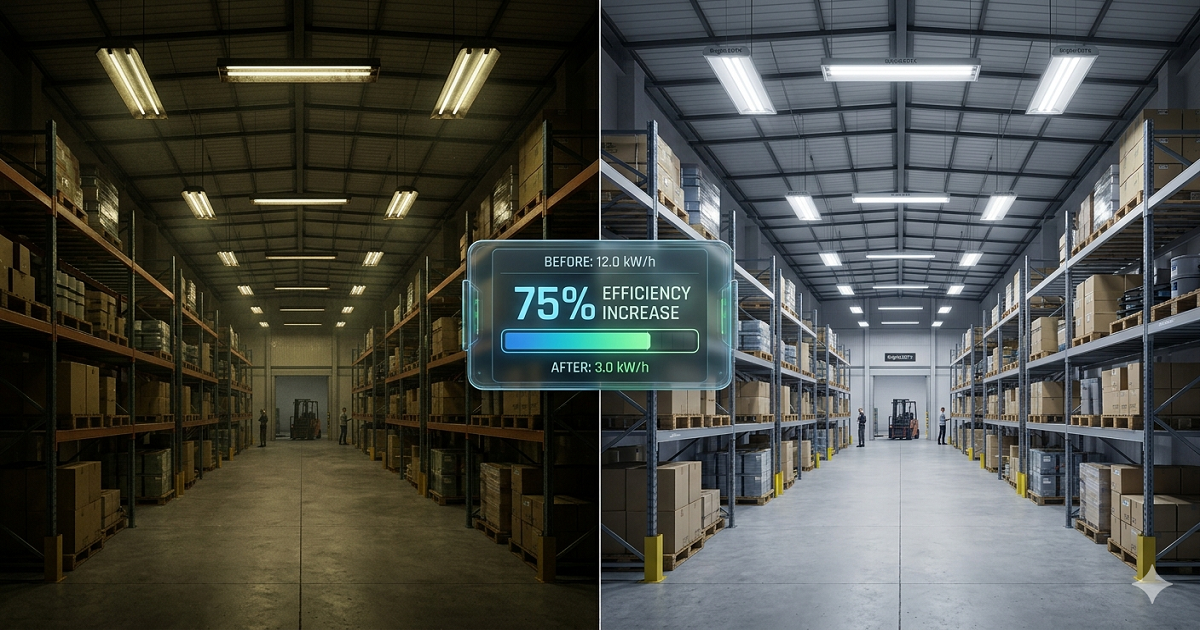
LED vs. Traditional Lighting: Cost Comparison & ROI Guide 2026
For Texas business owners, the question of whether or not to upgrade the lighting systems is now all about one simple question: Is the investment worth it? The answer is yes, and the reason is simple for the Texas business owners. Although the common types of lighting like Metal Halide (HID), High Pressure Sodium (HPS), and fluorescent lighting have always been the workhorse in the industrial industry, the answer to this question is no longer the same.
In 2026, not upgrading to new lighting solutions is not only a maintenance nightmare, but it is also a cash flow killer. This guide breaks down the "Total Cost of Ownership" to show how much your old lights are actually costing you compared to a modern commercial LED lighting solution in Texas.
The Direct Energy Expense: Watts vs. Lumens
The most obvious difference is in the energy usage. The conventional lighting sources are not highly energy saving, as they tend to consume a lot of watts to generate heat, and the light is a byproduct.
● Metal Halide (HID): A typical example of a warehouse setting with a high-bay lighting system has a 400W lamp with a 58W draw on the lamp known as the ballast draw; thus, the real usage is 458W.
● LED Equivalent: This is equivalent (or exceeds) the light output of a 150W LED lamp.
● The Math: With upgrading, you are saving 308W/lamp. You are saving more than 130,000 kWh in a place where there are 100 lights that are on 12 hours a day
The Maintenance Gap: Ending the "Lift Tax"
The traditional bulbs have a "decay curve." The bulbs get dim quickly, and the failure is frequent. The bulbs need to be replaced often. In Texas, with high ceilings the norm, the cost of the bulb is often insignificant compared to the cost of changing it.
Traditional Lighting Maintenance
● Lifespan: 15,000 to 20,000 hours.
● Recurring Costs: After every 2 years, you need to pay money to buy a new bulb, a new ballast and rent a scissor lift (500 or more per day).
● The "Group Re-lamp" Problem: If you only replace the bulbs one at a time, your maintenance crew is on site constantly.
LED Maintenance
● Lifespan: 100,000+ hours.
● Cost: Virtually zero for 10–12 years.
● Reliability: LEDs are solid-state technology with no glass to break or filaments to burn out.
The HVAC Connection: Removing the "Ceiling Heaters"
Texas summers are brutal, and traditional lights make them worse. A single HID bulb can reach internal temperatures of 1,000°F.
If you have 100 of these "ceiling heaters," your air conditioning system has to work much harder to keep the floor temperature comfortable for your workers. For every 3 watts of lighting energy you use, you'll save 1 watt of cooling energy. This "hidden" saving is a massive factor in the rapid ROI seen by Texas warehouses and retail stores.
Financial Breakdown: 5-Year Total Cost of Ownership (100 Fixtures)
|
Cost Factor (5-Year Period) |
Traditional (Metal Halide) |
Bright LED Solution |
|
Energy Consumption |
~275,000 kWh |
~90,000 kWh |
|
Estimated Energy Cost |
$33,000 |
$10,800 |
|
Replacement Parts |
$4,500 (Bulbs/Ballasts) |
$0 |
|
Labor & Lift Rentals |
$6,000 |
$0 |
|
TOTAL 5-YEAR COST |
$43,500 |
$10,800 |
ROI and the "Cost of Inaction"
The biggest mistake a business can make is waiting for the old bulbs to "burn out" before making a decision to upgrade. This is what we refer to as the Cost of Inaction. The longer those old fixtures sit in your ceiling, the longer they are actively draining capital that could be used to grow your business.
Your current utility bill is essentially a "hidden tax" on inefficiency. The longer you wait to make a decision, the more money you're essentially giving to the utility company to pay off a high-performance LED solution. The money is still being spent, it's just not being spent on a better light or a better asset.
The "Tipping Point" of Profitability
The vast majority of Bright LED projects in Texas have a full "breakeven" point in as short a time as 14 to 22 months. Once you have achieved that level, the thousands of dollars you save each month, which were formerly "avoided costs," immediately become part of your profit margins.
But the "burn out" strategy fails because traditional HID and Fluorescent lamps have a tendency to "burn out" before losing 40% of their former brightness. In other words, you have been paying 100% of the cost of the power to run the lamp, but only getting 60% of the light it once produced, for the last two years of the life of the lamp.
FAQs
If LEDs last so long, why do I see some "flickering" in other buildings?
Flickering is usually caused by a cheap LED driver. The LED chips themselves are never the problem. That's why we use only the best, industrial-grade drivers. A cheap LED might save you money today, but it will fail just like a traditional bulb.
Do LEDs get dimmer over time like my old lights?
Note that all lights depreciate to some extent in lumen depreciation, though LEDs do this to a much lesser extent. A Metal Halide light is capable of losing 50 percent of its brightness after 10 000 hours of usage. The LED light is of good quality and is able to retain 90 percent brightness for 50,000 hours of usage without depreciating.
How do I dispose of my old traditional bulbs?
Fluorescent lights and HID lights have mercury, which is a waste product. You can’t just throw them into the garbage. At Bright LED, we assist with the eco-friendly recycling and disposal of your old hazardous lighting as part of our LED retrofit process.
Are the savings different if I have a "demand" charge on my bill?
Yes! Most Texas commercial bills include a "Demand Charge" based on your highest point of usage. Since LEDs draw significantly less power at all times, they lower your "peak demand," which can lead to even deeper savings than the kWh reduction alone suggests.
What is the warranty on a typical LED upgrade?
We offer a 5-10 year warranty for our commercial fixtures. This covers the housing, the LEDs, and the driver. In contrast, traditional bulbs rarely come with any warranty once they are installed and turned on.


-
Straight vs. Tapered Light Poles: Which Offers Better Structural Integrity?
 June 9, 2026
 -
How to Choose the Right Commercial Light Pole: Steel vs. Aluminum
 June 5, 2026
 -
Best Practices for Specifying Round Steel Poles for Commercial Parking Lots
 June 2, 2026
 -
LED Emergency Exit Signs: Installation Guide for Commercial Buildings (2026)
 May 26, 2026
 -
LED Emergency Battery Backup Systems for Commercial Lighting & Businesses
 May 23, 2026