
Energy Rebate Guides For Texas Businesses
Energy Rebate Guides For Texas Businesses
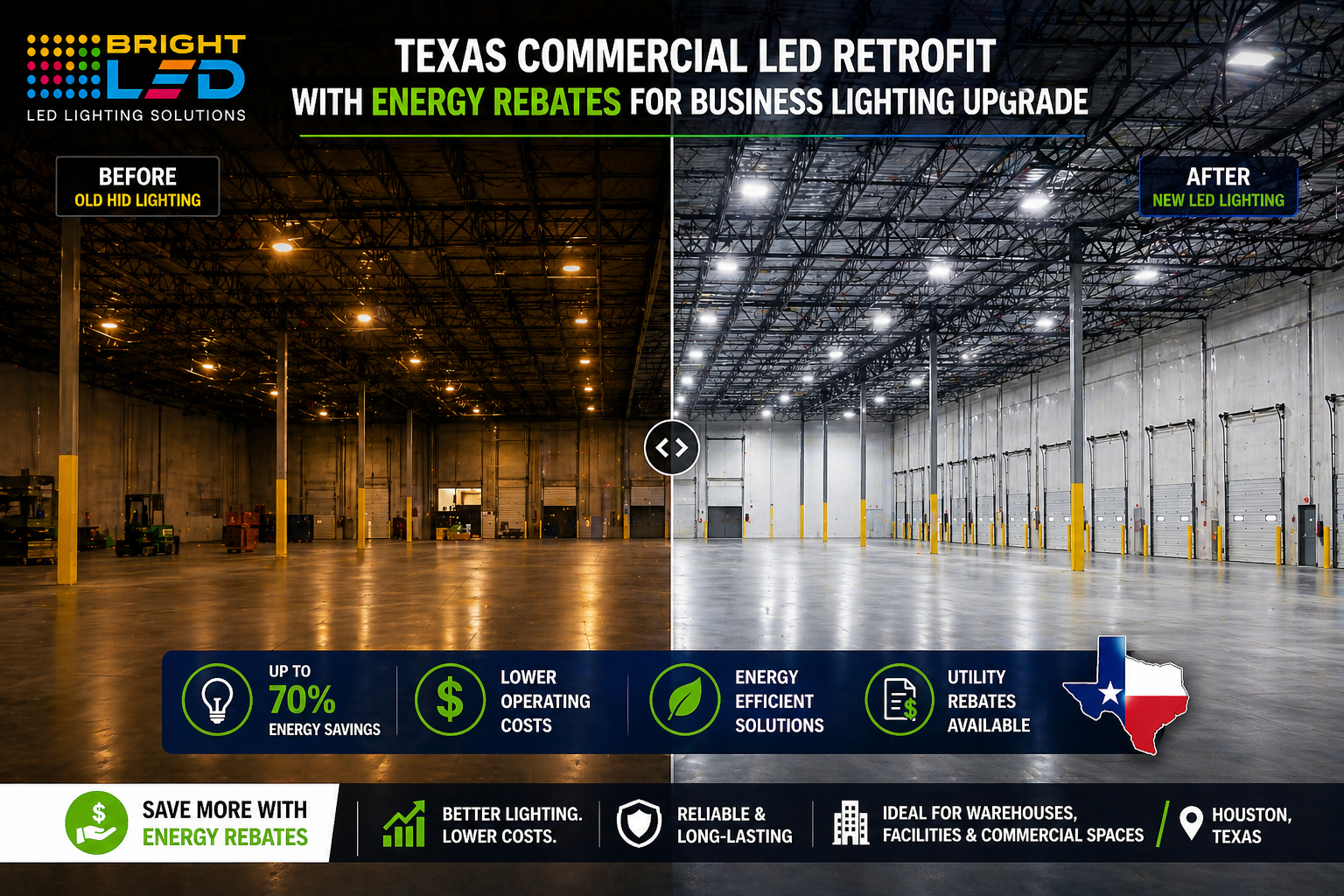
For many Texas business owners, the upfront cost of a commercial LED lighting retrofit Texas project can feel like a significant hurdle. However, there is a "hidden" financial ecosystem designed to help you cross that finish line. Because the Texas power grid (ERCOT) faces increasing pressure during our legendary summer heatwaves, utility companies are more than willing to pay you to reduce your energy consumption.
In 2026, these incentives are no longer just "nice to have"; they are a core part of a smart business strategy. Navigating Energy Rebate Guides for Texas Businesses can effectively lower your project’s initial investment by 30% to 70%, turning a high-tech upgrade into an immediate financial win.
The "Big Three" Utility Programs in Texas
The energy market is deregulated in Texas. It is used to mean that at the same time you select who you purchase your electricity from (your retail electric company), it is the company that owns and maintains the poles and wires (the transmission and distribution company) that provides your rebates.
Oncor (Dallas / Fort Worth & North Texas)
Oncor has one of the strongest commercial incentive programs in the US. They give attention to on-demand savings, which implies that the higher the maximum amount of power your facility consumes at any particular moment, the more they will compensate you.
● Prescriptive Rebates: Fixed amounts for standard upgrades like LED high bays or office panels.
● Custom Incentives: For larger industrial facilities that implement advanced controls or specialized HVAC optimizations.
CenterPoint Energy (Houston & Gulf Coast)
CenterPoint’s programs are heavily utilized by the massive industrial and warehouse sectors near the Port of Houston.
● Standard Offer Programs: These pay per kilowatt-hour (kWh) saved—the more efficient the fixture, the higher the payout.
● Small Commercial Program: It is bespoke to small-sized businesses that do not necessarily have a colossal presence but need to modernize.
CPS Energy (San Antonio)
As a municipally owned utility, CPS Energy has its own unique set of incentives. Their "Big Fix" and "Commercial Rebate" programs are designed to help San Antonio businesses meet city-wide sustainability goals while lowering operational costs.
How the Rebate Process Works
Most business proprietors fail to claim the rebates since they feel that the procedure is too complex. While there is paperwork involved, the roadmap is generally standardized across the state.
● Pre-Approval: Most Texas rebates require an "Initial Application" before the old lights are taken down. You can lose your incentive by installing the new ones prior to receiving the green light.
● Qualified Products: Fixtures should be included in the DesignLights Consortium (DLC) or Energy Star QPL (Qualified Products List). In the case of Bright LED, we will exclusively be using DLC Premium-rated hardware to make the most out of rebates.
● Post-Installation Inspection: After the project is finished, a utility representative can be sent to ensure that the equipment is the one that is being used.
Beyond the Utility Bill: Federal Tax Incentives (Section 179D)
In addition to the immediate cash back from your utility provider, the federal government offers a massive tax "kicker." The Section 179D Commercial Buildings Energy-Efficiency Tax Deduction was significantly expanded for 2026.
The Benefits of 179D
● Higher Deductions: Depending on the efficiency gain, businesses can deduct up to $5.00 per square foot.
● Immediate Write-off: This allows you to accelerate the depreciation of your lighting assets, significantly lowering your taxable income for the year.
● Government Alignment: This deduction is designed to work with your local utility rebates, not instead of them.
Why Utility Companies Want to Give You Money
It might seem counterintuitive for a power company to help you buy less of their product. However, it’s a matter of grid stability.
● Avoiding New Power Plants: It costs a utility company less to pay you in order to conserve 1,000 watts than it costs to construct a new power-generating facility in order to generate those 1,000 watts.
● Grid Resilience: When the demand peaks (such as on a 105degF afternoon in August in Austin) all of the LED fixtures can help avoid rolling blackouts as the overall load becomes manageable.
FAQs
How much of my project cost can a rebate actually cover?
In Texas, utility rebates on a well-planned retrofit of LEDs will cover 30 to 50 percent of the project cost. This number could even reach 70 percent in certain highly efficient scenarios that use smart sensors and automated controls, especially when combined with energy-efficient lighting upgrades.
Do I have to fill out all the paperwork myself?
At Bright LED Tx, we handle the heavy lifting. We perform the energy audit, collect the technical spec sheets, and manage the application with Oncor, CenterPoint, or CPS to ensure you receive the maximum possible incentive without the administrative headache.
Does my business qualify if I rent my space?
Yes! In most cases, the rebate can be paid either to the property owner or the tenant, depending on who is funding the project. No matter how short the duration of the lease may be, even with a short-term lease, the energy savings alone are usually enough to offset the upgrade in 12 months.
What is the difference between "prescriptive" and "custom" rebates?
"Prescriptive" rebates are like a menu; you get a fixed dollar amount for every fixture you replace. Custom rebates are based on a complex calculation of total energy saved over a year and are usually reserved for large-scale industrial projects or specialized cooling solutions.
Are rebates available for new construction?
Yes, most Texas utilities have "New Construction" programs that provide incentives for builders who exceed the current energy code requirements. It is much more cost-effective to build with efficiency in mind than to retrofit later.


-
Straight vs. Tapered Light Poles: Which Offers Better Structural Integrity?
 June 9, 2026
 -
How to Choose the Right Commercial Light Pole: Steel vs. Aluminum
 June 5, 2026
 -
Best Practices for Specifying Round Steel Poles for Commercial Parking Lots
 June 2, 2026
 -
LED Emergency Exit Signs: Installation Guide for Commercial Buildings (2026)
 May 26, 2026
 -
LED Emergency Battery Backup Systems for Commercial Lighting & Businesses
 May 23, 2026