
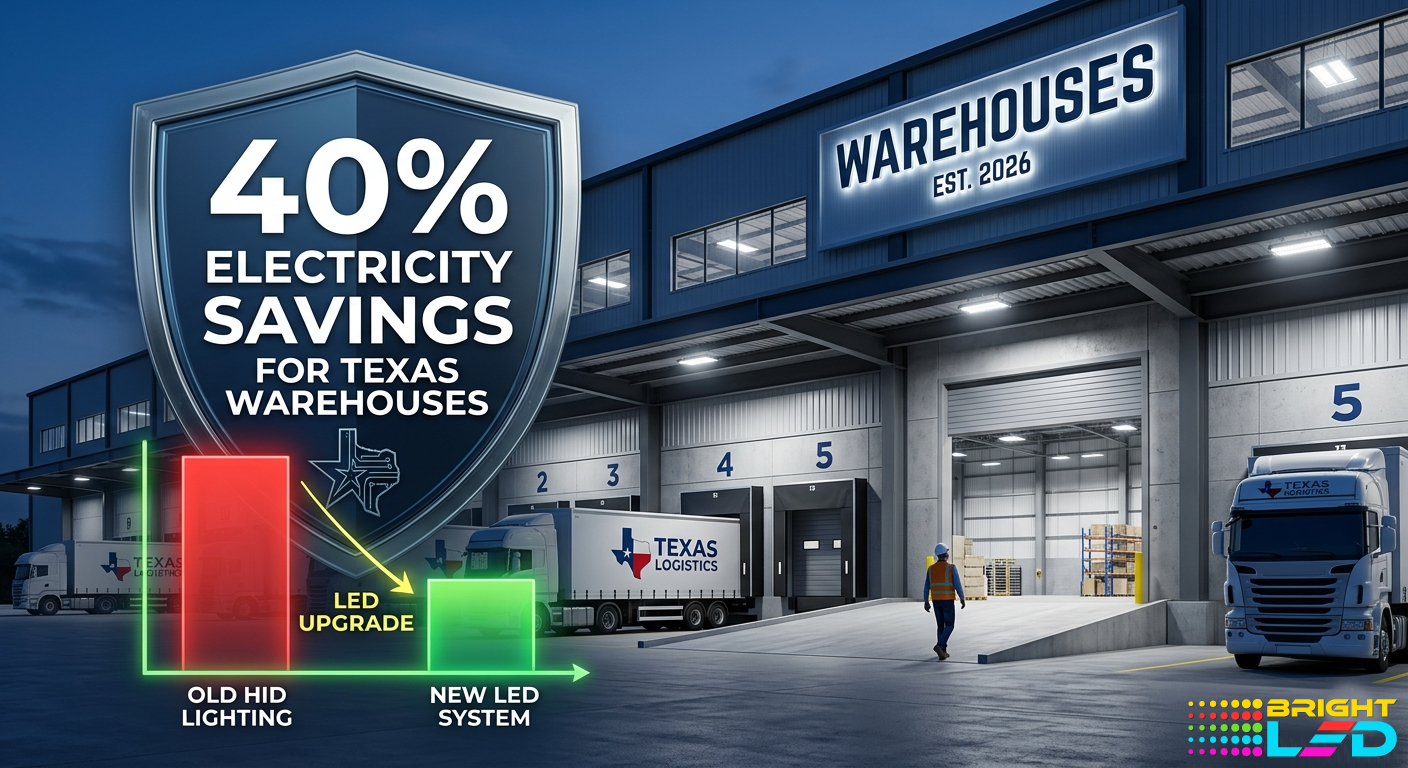
How to Save 40% on Electricity Bills for Texas Warehouses
How to Save 40% on Electricity Bills for Texas Warehouses
In the competitive landscape of Texas industrial operations, electricity is often the second-largest overhead cost after labor. In Houston, Dallas, and San Antonio (or in other cities), to most warehouse managers, a monthly utility bill of $10,000 to $50,000 is considered as a fixed cost.
Nonetheless, even according to 2026 standards, such high prices are usually achieved with the help of aged technology and inefficient energy behavior. With a minor set of industrial improvements in place, the majority of facilities in Texas can reduce their electricity spending by forty percent. The following guide is an outline of the blueprint on how to transform your warehouse into an efficient, energy saving machine.
The "Big Three" of Warehouse Energy Waste
To save 40%, you must first understand where the power is going. There are three major areas that dominate the energy usage in a normal and unconditioned or semi-conditioned Texas warehouse:
● Lighting (30-50%): High-bay fixtures running 24/7.
● HVAC & Air Movement (25-40%): Fighting the Texas humidity and heat.
● Phantom Loads & Equipment (10-15%): Idle chargers, conveyors, and outdated machinery.
Strategy 1: The LED High-Bay Revolution
Lighting is the easiest "quick win" for Texas warehouses. Traditional Metal Halide or High-Pressure Sodium (HPS) fixtures are essentially heaters that happen to produce light.
Why HID Lighting is Costing You Double
An average 400W Metal Halide actually pulls even nearer to 450W when you add in the ballast. Moreover, they emit 90 percent of energy in the form of infrared heat. During a summer in Houston, a cooling system must go twice the effort to eliminate the heat produced by your lights.
The LED Advantage
By changing to a Bright LED solution, the draw of the fixtures will be about 150W where the light output is the same.
● Instant Savings: Immediate 60-70% reduction in lighting energy.
● Reduced Heat Load: LEDs stay cool, lowering your HVAC strain.
● Occupancy Sensors: The inclusion of motion sensors will mean that lights can only consume power when an aisle is in use and in many cases, this will push overall lighting savings over 80 percent.
Strategy 2: Taming the Texas Heat Without Breaking the Bank
The Texas warehouses have a special challenge: the heat bubble. There is stagnant air at the ceiling that can go as high as 120 degrees Fahrenheit, and as such, the fans and AC units must be run full throttle.
High-Volume, Low-Speed (HVLS) Fans
Big industrial fans do not just move the air; they also destratify it. By mixing the hot air at the ceiling with cooler air at the floor, you create a "perceived cooling" effect of 8 to 10 degrees for your workers.
Thermostat adjustment perceived cooling allows you to raise your AC setpoint without sacrificing comfort, saving roughly 3% on cooling costs for every degree you raise the thermostat.
Dock Seals and Insulation
If you can see daylight coming through your doors of the loading dock, you are literally air-conditioning the outdoors.
● Weather Stripping: Simple kits can be used to seal the gaps that otherwise leak expensive conditioned air.
● Insulated Curtains: In refrigerated or air-conditioned areas, high-speed doors or air curtains ensure the absence of huge power waste during the loading process.
Strategy 3: Exploiting Texas Energy Rebates & Incentives
You don't have to fund your 40% savings blueprint alone. Texas utility providers like Oncor, CenterPoint Energy, and CPS Energy offer massive rebates for commercial energy efficiency.
How to Get Paid to Upgrade
There are many programs that provide "prescriptive" and "custom" rebates based on the amount of energy you save.
● Oncor (Dallas/FW): Offers incentives that can cover up to 30-50% of the total cost of an LED retrofit.
● CenterPoint (Houston): Provides rebates for high-efficiency lighting, motors, and HVAC tune-ups.
● Federal Section 179D: The deduction of tax on energy-efficient commercial buildings in 2026 is a very potent instrument, and the maximum deduction per square foot within this category is 5.00 dollars.
The Texas Efficiency Matrix: Projected Savings by Action Item
|
Step |
Action Item |
Expected Savings |
|
1 |
Retrofit HID fixtures with Bright LED high bays. |
25-30% of the total bill |
|
2 |
Install Motion Sensors in low-traffic aisles |
5-10% of the total bill |
|
3 |
Seal Dock Doors and enhance roof insulation |
3-5% of the total bill |
|
4 |
Optimize HVAC setpoints with HVLS fans |
5-7% of the total bill |
|
Total |
Comprehensive Efficiency Overhaul |
~40-45% Savings |
FAQ
How long does it take to see the 40% savings?
The energy reduction is something that you will encounter in your very first utility bill after the upgrades have been implemented. In terms of "payback" for the investment, most Texas warehouses reach a 100% ROI in 12 to 18 months when factoring in energy savings and utility rebates.
Do LED lights really help with my AC bill?
Yes. The conventional warehouse lighting is nothing but a space heater. Replacing all your internal heat sources with cool-running LEDs means that your HVAC system can switch off more often.
Can I get a rebate for my specific Texas location?
Most "deregulated" areas of Texas (Oncor, CenterPoint, TNMP, and AEP) have active commercial rebate programs. Even "municipally owned" utilities like CPS Energy in San Antonio and Austin Energy have robust incentives. At Bright LED, we handle the paperwork to ensure you get every dollar available.
What is the most expensive part of the electricity bill?
In Texas, "demand charges" are often the most expensive part. These are based on your highest 15-minute window of usage. High-efficiency lighting and smart HVAC controls help "smooth out" these peaks, lowering your demand charges significantly.
Will my warehouse operations have to stop during the installation?
We understand that in the logistics business, downtime is the enemy. You don't have to choose between a reduced bill and meeting your shipping deadlines. Most upgrades can be done in an "active" environment by working in specific zones or off-peak shifts. In fact, because of the quick-connect nature of our LED high-bays, a single aisle can be upgraded in a matter of hours, not days. We work around your forklift schedules, not the other way around.


-
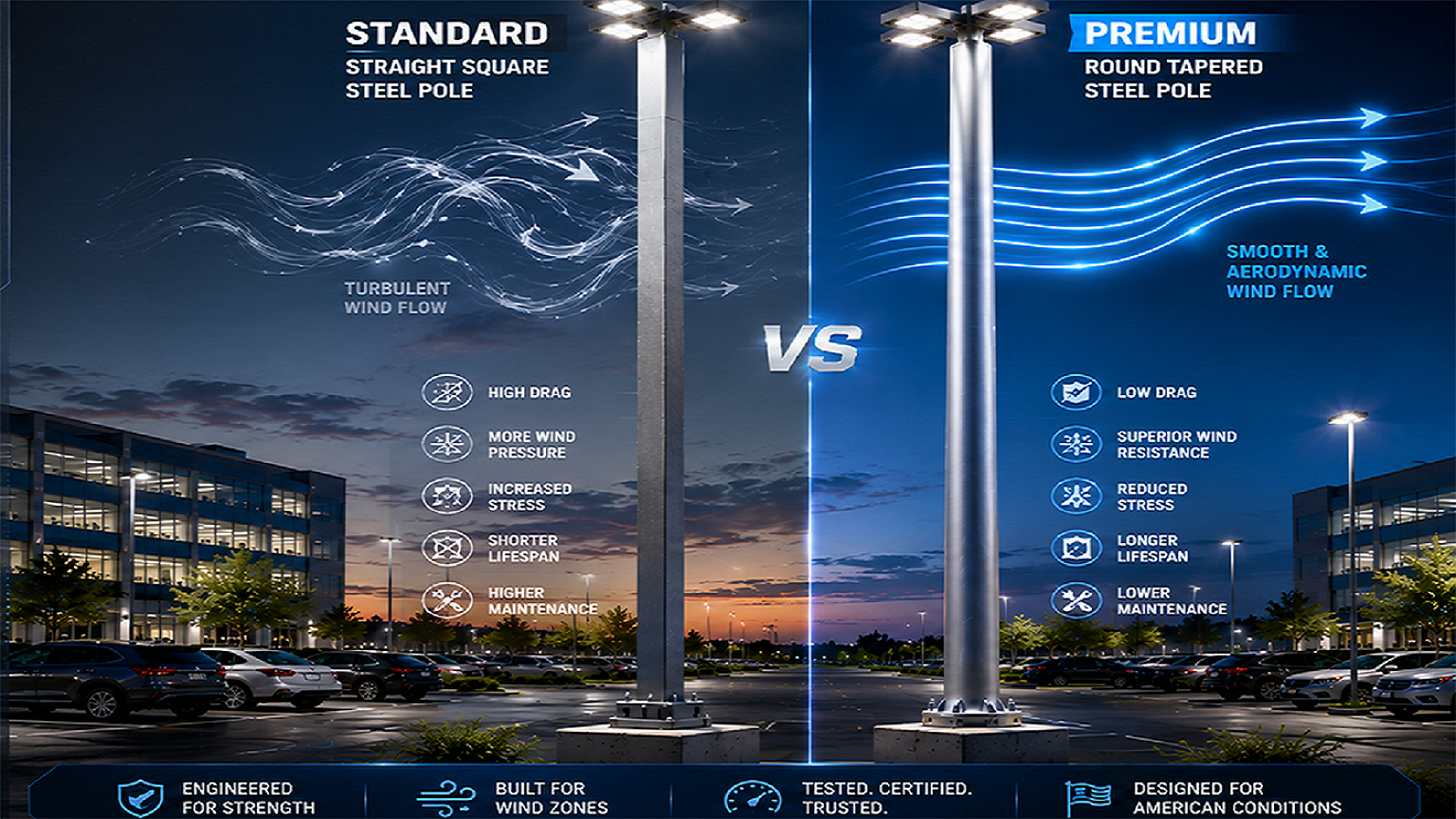
Straight vs. Tapered Light Poles: Which Offers Better Structural Integrity?
 June 9, 2026
 -
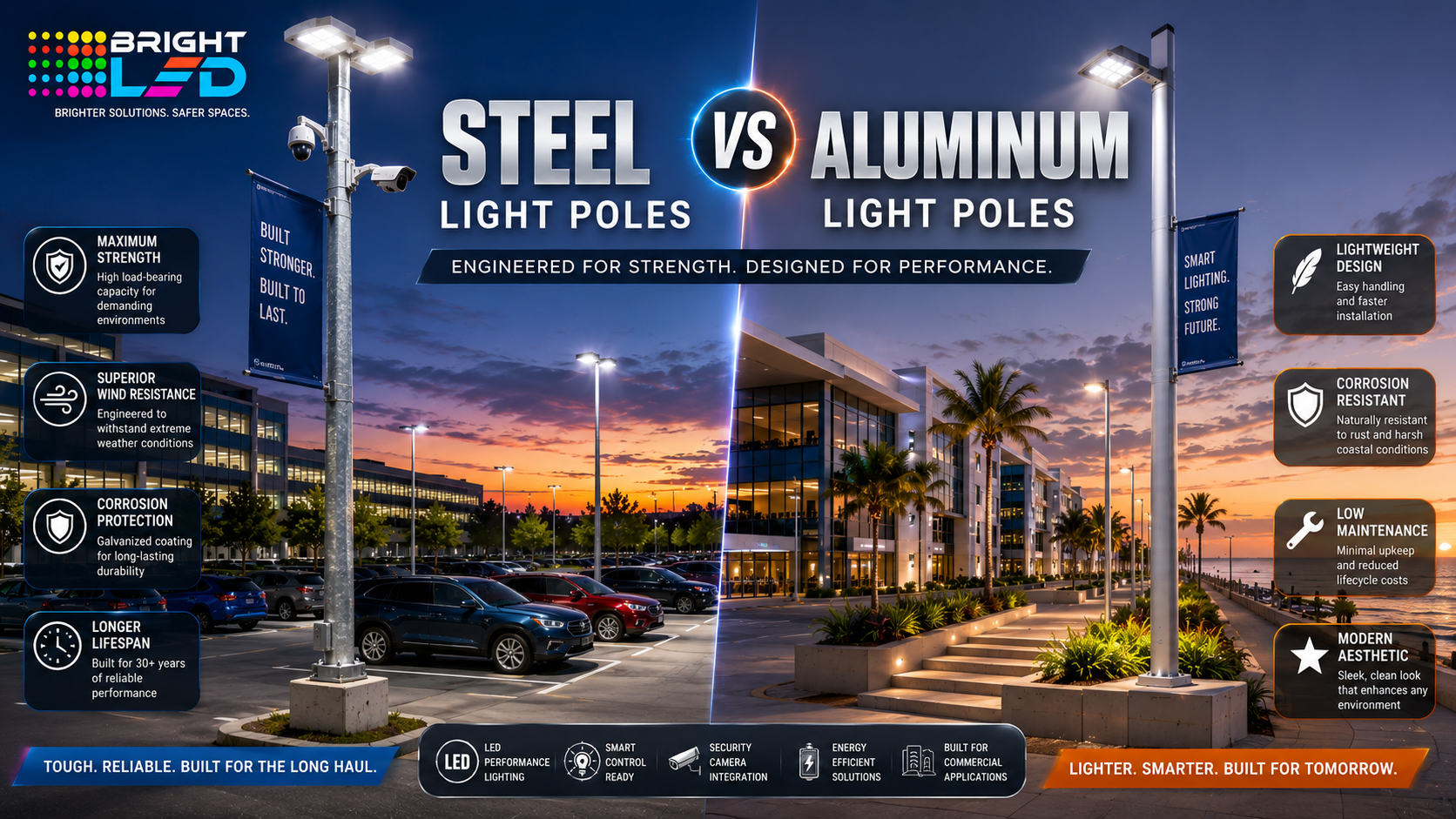
How to Choose the Right Commercial Light Pole: Steel vs. Aluminum
 June 5, 2026
 -
Best Practices for Specifying Round Steel Poles for Commercial Parking Lots
 June 2, 2026
 -
LED Emergency Exit Signs: Installation Guide for Commercial Buildings (2026)
 May 26, 2026
 -
LED Emergency Battery Backup Systems for Commercial Lighting & Businesses
 May 23, 2026